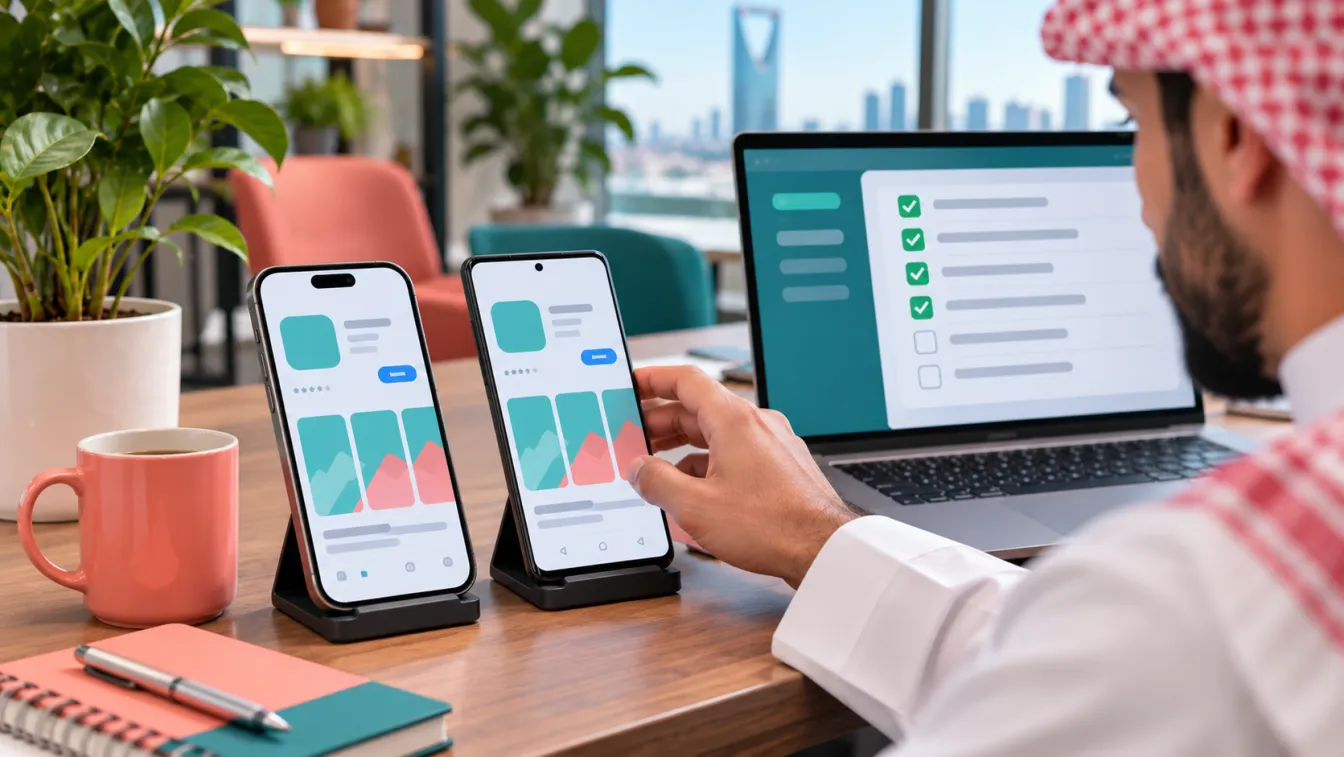


MVP app development is about deciding which capabilities your business needs to launch a useful first version of an application, without trying to build every possible feature at once. The goal is to deliver a working product that solves a specific problem and gives the business a practical foundation for future improvements.
For a Saudi business, this means choosing the right customer experience, operational workflows, backend, administration tools and integrations before development begins. At LtsThink, we help businesses make these decisions through our mobile app development services in Saudi Arabia, combining product planning with Arabic-first design, Flutter or native development and backend implementation.
What is MVP app development?
A Minimum Viable Product (MVP) is the first usable version of a product that includes the essential capabilities needed to address a clearly defined customer or business problem.
It is not simply a smaller application. It is a deliberate product decision about what must be available at launch and what can be introduced later.
Consider a hypothetical Saudi grocery delivery business. Its long-term vision may include customer ordering, driver management, loyalty rewards, subscriptions, promotional campaigns, multiple branches and advanced business reporting.
Building everything immediately may introduce unnecessary complexity. An initial release could instead focus on:
- Customer registration and account management.
- Browsing available products.
- Adding products to a shopping basket.
- Completing an order through a supported payment method.
- Viewing order status.
- Managing products and incoming orders through an administration panel.
These capabilities establish a complete operational experience. Loyalty programmes, advanced promotions and additional business features can be considered for later releases when there is a clear reason to introduce them.
The objective is not to remove important functionality. It is to deliver a coherent first product with a defined purpose and a manageable scope.
1. Start with one clear business problem
Before deciding which features belong in the first release, identify the problem the application is intended to solve.
A vague objective such as "we need an app for our business" is not enough to guide product decisions. You need to explain who has the problem, how it affects the current process and what a successful solution should enable.
For example, imagine a hypothetical property maintenance company that receives customer requests through phone calls and messaging channels. Its main problem is not the absence of a mobile application. It is the difficulty of organising requests, assigning technicians and keeping customers informed.
Its first product objective could be:
Enable customers to submit maintenance requests and allow the operations team to assign and track those requests through one connected system.
This objective creates a useful filter for feature decisions. A capability that does not contribute to the initial customer journey or operational process may not need to be included in the first release.
Ask the business stakeholders:
- Which customer problem must the first version solve?
- Which user group should the initial release serve?
- What is the most important business process to support?
- Which existing process will the application replace or improve?
- What would make the first release genuinely usable?
The answers should be documented before the feature list is finalised.
2. Define the complete product vision before reducing scope
A common mistake is to define an MVP by starting with a very small feature list. This can lead to an incomplete understanding of the actual product.
Instead, first identify the broader product vision and its expected capabilities. Then decide which of those capabilities belong in the initial release.
Your product vision should cover:
- Target customers and their needs.
- Business objectives and operational requirements.
- Main user roles and responsibilities.
- Core customer and employee journeys.
- Required business systems and integrations.
- Security, privacy and language expectations.
- Future capabilities that may become relevant.
For a hypothetical appointment booking platform, the complete vision might include customer bookings, staff calendars, service management, reminders, online payments, customer history and business reporting.
The first release does not necessarily need every reporting or customer engagement feature. However, the architecture and requirements should account for important dependencies so that later development does not require avoidable redesign.
This is where a written mobile app requirements document becomes valuable. It describes the complete business needs, user roles, workflows, integrations and acceptance criteria. MVP planning then uses that information to decide what will actually ship first.
3. MVP app development: separate essential features from future enhancements
Once the complete product requirements are understood, organise features according to their importance to the first usable release.
A practical approach is to divide them into three groups.
Must-have: Required for the first release
These capabilities are necessary to complete the main user journey or operate the service safely and reliably.
For a hypothetical booking application, they might include:
- Customer registration and login.
- Viewing available services.
- Selecting an available appointment.
- Confirming and managing a booking.
- An administration interface for managing availability.
- Notifications for important booking events.
If removing a feature prevents the core service from working, it probably belongs in this group.
Should-have: Important but not essential at launch
These features improve the experience or operational efficiency but may not be necessary to establish the initial product.
Examples include:
- Customer preferences and saved services.
- Advanced appointment filtering.
- Additional reporting and management views.
- More flexible notification preferences.
- Enhanced customer support workflows.
Whether a feature belongs in the first release depends on the business context. A capability that is optional for one business may be essential for another.
Could-have: Suitable for a later phase
These are enhancements that may add value after the core product is working.
Examples include:
- Loyalty and rewards programmes.
- Advanced personalisation.
- Referral campaigns.
- Additional language experiences.
- More complex automation.
- Advanced analytics and forecasting.
Do not treat this category as a permanent exclusion. Record the features in a future development backlog so they can be evaluated when the business has a clearer understanding of its priorities.
4. Prioritise complete user journeys, not isolated screens
A mobile application can contain attractive screens and still fail to deliver a usable service. The first release should support complete journeys from the user's starting point to a meaningful outcome.
Consider a hypothetical retail application. A customer journey might include:
- Opening the application.
- Registering or signing in.
- Browsing the available products.
- Selecting a product and adding it to the basket.
- Reviewing the order details.
- Completing payment through the agreed method.
- Receiving an order confirmation.
- Checking the order status.
If the application supports product browsing but cannot complete an order, the primary business journey remains unfinished.
The same principle applies to the administration side. If employees need to receive orders, update inventory or manage fulfilment, the required controls must also exist in the backend and administration panel.
During MVP app development, assess every proposed feature against the complete journey it supports. Ask whether customers and employees can complete the intended task without relying on undocumented manual workarounds.
A working first release should include the necessary customer interface, backend operations and administrative capabilities. It should not leave essential business processes outside the product simply to reduce the visible number of screens.
5. Decide what belongs in the first release technically
Feature prioritisation must also account for the technical components required to make those features work.
A typical mobile application may contain several connected components:
- Customer application: The iOS and Android experience used by customers or employees.
- Backend: Business logic, APIs, authentication, data processing and application services.
- Database: Structured storage for accounts, products, bookings, orders and operational records.
- Admin panel: Tools for authorised staff to manage users, content, transactions and business operations.
- Integrations: Connections to payment services, ERP, CRM, POS, maps and communication providers where needed.
- Monitoring and support: Error tracking, operational monitoring, backups and maintenance capabilities.
Not every project needs every component, but the dependencies of the chosen features must be understood.
For example, a delivery application may need a customer interface, an order management backend, a dispatch workflow and a driver interface. A simple customer-only application may not be sufficient if the business cannot process and manage the orders it receives.
At LtsThink, we plan the mobile experience and supporting systems together. Depending on the requirements, the solution may use Flutter or native iOS and Android development, with a backend and administration panel built by the same team.
The choice between technologies should follow the product requirements, integration needs, device capabilities and long-term maintenance expectations.
6. Plan integrations without overloading the first release
Integrations can be essential to the business, but not every possible connection must be implemented immediately.
Start by identifying which external systems are necessary for the core product to operate.
Common integration categories include:
- Payments: Supported payment services and transaction-status handling.
- ERP: Inventory, accounting, invoices and operational information.
- CRM: Customer records, enquiries and interaction history.
- POS: Retail transactions, products and branch information.
- Maps: Location selection, addresses and navigation.
- Communication: Push notifications, email and SMS services.
- Other APIs: Delivery providers, booking systems and third-party business platforms.
For each proposed integration, determine whether it is essential for the first release, whether the required API access is available and whether another organisation must approve the connection.
A hypothetical retail business may need inventory synchronisation from its existing ERP before it can safely accept orders. An advanced CRM marketing connection, however, may be postponed if the first release can operate using the agreed customer management process.
Do not postpone an integration if doing so would create inaccurate inventory, unreliable transactions, duplicated records or unacceptable operational risk.
For Saudi applications, consider local payment requirements, Arabic experiences and applicable personal-data handling expectations. Where PDPL, hosting or data-residency considerations apply, or where an application handles healthcare or financial information, the business should confirm the specific requirements with the relevant authority or qualified adviser.
7. Build quality and security into MVP app development
An MVP should have a limited feature scope, not reduced quality standards.
Users should not be expected to tolerate insecure authentication, unreliable transactions, confusing navigation or incorrect data simply because the application is in its first release.
Include essential quality requirements from the beginning:
- Secure authentication and appropriate role-based permissions.
- Protection of personal and business information.
- Reliable handling of payments and important transactions.
- Validation of submitted information.
- Clear error messages and recovery paths.
- Testing across the intended devices and operating systems.
- Arabic RTL and English interface validation where both languages are supported.
- Monitoring, backups and a defined maintenance process.
Also establish acceptance criteria for the main journeys. A successful order, for example, should have a clear confirmation state, a recorded transaction status and the expected administrative visibility.
An MVP should be ready for its intended operational environment. Its scope may be smaller than the full product vision, but its essential capabilities should be dependable.
8. Plan future releases using a prioritised backlog
The first release is the beginning of product development, not the end of the product roadmap.
Create a backlog that records features not included in the initial release. Each item should have a clear description, business reason, dependencies and suggested priority.
A practical release structure could look like this:
- Initial release: Core customer journey, essential administration, required integrations and fundamental operational controls.
- Next enhancement phase: Improvements identified through user feedback, additional operational features and refinements to existing workflows.
- Expanded product phase: Advanced automation, loyalty features, additional integrations, reporting and more specialised experiences.
These phases are illustrative, not a commitment to specific delivery dates. Their scope should be reviewed as the business learns more about actual usage and operational needs.
Avoid promising future features before understanding their dependencies. A new capability may require changes to the backend, database, permissions, external integrations or business procedures.
Product decisions should be revisited using evidence from customer feedback, support requests, operational problems and the business's evolving priorities.
9. Measure whether the first version is working
A successful first release should be evaluated against its original business objective rather than the number of features delivered.
Choose practical indicators that reflect the actual product and its customer journey.
For a hypothetical delivery service, relevant indicators might include:
- Whether customers can complete an order without assistance.
- Whether order information reaches the administration system correctly.
- Whether customers can understand the delivery status.
- Whether staff can process and manage orders through the intended workflow.
- Whether payment and notification events are recorded correctly.
- Which steps generate customer questions or operational difficulties.
For a booking application, the business may examine incomplete booking attempts, appointment changes, missed notifications and staff difficulties managing availability.
Avoid collecting unnecessary personal information or treating every available analytics event as useful. Decide what needs to be measured, why it matters and who is authorised to access the information.
Use the findings to decide which backlog items deserve attention. User feedback should inform product decisions, but individual requests should still be assessed against the overall business objective.
10. When should MVP app development pause before launch?
A smaller release is not automatically ready for launch. Some missing capabilities can prevent a product from operating safely or delivering its promised service.
Consider postponing the launch if:
- The primary customer journey cannot be completed.
- Essential administration and operational controls are missing.
- Payment or transaction handling has not been properly tested.
- Important data is inconsistent between connected systems.
- User permissions expose information to unauthorised people.
- The application has unresolved critical defects.
- There is no clear process for handling support requests or operational incidents.
- The business has not identified who will manage the application after release.
If the product depends on an external provider, confirm that the necessary access and integration capabilities are available before treating the feature as launch-ready.
A responsible launch decision considers whether the product is useful, reliable and supportable, not simply whether the development team has finished implementing the selected screens.
11. Prepare your MVP app development scope before requesting a proposal
Before approaching an app development company, organise the information needed to estimate and plan the first release.
Prepare:
- Product objective: The problem being solved and the intended business outcome.
- Target users: The audiences and user roles supported by the application.
- Complete product requirements: The overall capabilities and workflows expected from the product.
- First-release features: The exact functionality that must ship initially.
- Deferred features: Capabilities reserved for later phases and the reasons for postponing them.
- Technical scope: iOS and Android requirements, backend, database and administration panel.
- Integration requirements: Existing business systems, external APIs and access dependencies.
- Quality expectations: Security, privacy, performance, compatibility and language requirements.
- Acceptance criteria: Conditions for testing and approving the first release.
- Post-launch responsibilities: Maintenance, monitoring, support, ownership and future improvements.
The development team should review the complete requirements and the proposed MVP scope together. This makes it easier to identify dependencies, exclusions and risks before agreeing on the project.
At LtsThink, our discovery process helps Saudi businesses define the first release without losing sight of the broader product. We review the customer experience, business workflows, integrations and technical requirements before preparing a fixed-price proposal based on the agreed scope.
The result should be a product that can be launched, operated and improved with a clear understanding of what comes next.
Work with us: Looking for an app development company in Riyadh or a team that works across the Kingdom? Planning your first mobile application release? Discuss your MVP and mobile app development project with LtsThink. If you are still defining the product scope, read our guide to the mobile app requirements document in Saudi Arabia before deciding which capabilities belong in the first release.
FAQ
What does MVP mean in mobile app development?
MVP stands for Minimum Viable Product. It is the first usable version of an application that includes the essential capabilities required to solve a defined customer or business problem. Additional features can be introduced in later releases.
How do I decide which features belong in the first app release?
Start with the primary customer journey and the operational processes needed to support it. Include essential functionality, security, administration and required integrations. Defer enhancements that do not prevent the core product from working, and record them in a prioritised future backlog.
Does an MVP need an admin panel and backend?
It depends on the application, but many business apps require both. If employees need to manage orders, bookings, users, products or service requests, the backend and administration tools are part of the working product rather than optional extras.
Is an MVP an unfinished or low-quality application?
No. An MVP has a deliberately limited feature scope, but its included capabilities should work reliably, securely and as agreed. It should be suitable for its intended users and supported by an appropriate maintenance process.