

Healthcare is a trust-led business. Before a patient books an appointment, they are already forming an impression from your clinic name, website, signage, social media and the way your team communicates. Effective healthcare branding brings these experiences together into a clear, credible identity that helps patients understand who you are and what they can expect.
For clinics and medical centers in Saudi Arabia, a strong brand is not simply an attractive logo. It is a practical system for communicating your speciality, approach to care and professional standards. A thoughtful branding strategy helps define that system before visual decisions are made.
Why healthcare branding matters for clinics
Patients often compare healthcare providers while dealing with uncertainty, discomfort or an important personal decision. Your brand cannot replace clinical quality, but it can make your services easier to understand and your organisation easier to approach. Consistent communication helps people recognise your clinic, understand its services and know what to do next.
A well-defined identity can support several business objectives:
- Clarity: Explain your specialities, services and patient groups without relying on vague claims.
- Recognition: Create a consistent appearance across your location, digital channels and printed materials.
- Confidence: Present information in a professional, calm and understandable way.
- Differentiation: Communicate what makes your clinic's approach distinctive without making unsupported superiority claims.
- Consistency: Help reception, administration, marketing and clinical teams communicate with the same overall voice.
The objective is not to make healthcare feel like a retail product. It is to reduce confusion and communicate care with professionalism and respect.
Start with positioning, not the logo
One of the most common mistakes in healthcare branding is beginning with colours, symbols or logo references before deciding what the clinic should stand for. Visual design cannot solve unclear positioning.
Start by answering a few foundational questions:
- Who do you serve? Define the patient groups and communities the clinic is designed to support. A family medical centre, a specialist dermatology clinic and a diagnostic centre have different audiences and expectations.
- What do you provide? Identify the core specialities and services. Avoid presenting every possible service as equally important if some are central to the business and others are supporting services.
- What is your approach? Describe the experience you want to deliver, such as clear explanations, coordinated appointments, specialist-led care or convenient access.
- Why should patients consider you? Identify genuine differences in your service model, expertise, facilities or patient journey. Do not turn ordinary operational features into exaggerated promises.
- What should people remember? Reduce the positioning to a clear idea that can guide the website, identity and everyday communication.
For example, a hypothetical family clinic may decide that its central promise is approachable, coordinated primary care for households. A specialist clinic may instead focus on explaining complex services in a reassuring and accessible way. These are strategic choices, not ready-made slogans.
A clear position also makes it easier to brief designers and evaluate creative work. If your team needs help defining that direction, explore our brand strategy service.
Build a visual identity that feels professional and approachable
The visual identity should express the clinic's positioning while remaining legible, flexible and appropriate for a healthcare environment. It needs to work on a building sign, appointment card, website header, staff document and mobile screen.
Logo and visual recognition
A healthcare logo should be distinctive without becoming complicated. Medical crosses, hearts, leaves and abstract human figures are familiar visual references, but they are not automatically the right choice. Using a common symbol without a distinctive design system can make a clinic difficult to recognise.
Consider the following before approving a logo:
- Is it readable at small sizes and from a distance?
- Does it work in one colour as well as in the full colour version?
- Can it be applied to signage, uniforms, documents and digital interfaces?
- Does it suit the clinic's speciality and intended audience?
- Is it sufficiently distinctive from nearby competitors and existing registered marks?
Colour and typography
Colour influences the overall impression, but there is no single colour palette that makes a healthcare provider trustworthy. Blue and green are common in the sector, yet the right palette depends on the clinic's positioning, audience and environment.
Choose colours with sufficient contrast and test them in real applications. A palette that looks elegant on a presentation slide may become difficult to read on a reception sign or mobile screen. Typography needs the same practical attention. Arabic and English fonts should remain legible, work together visually and support the clinic's actual content needs.
Photography and graphic elements
Use imagery that reflects the real experience you want to communicate. Clean facilities, professional environments and respectful human interactions can help explain the clinic's atmosphere. Avoid generic stock photographs that suggest services or equipment the clinic does not offer.
Photography involving patients or identifiable individuals requires appropriate permissions and careful handling. Visual communication should respect privacy and dignity rather than treating patient stories as promotional decoration.
Design the patient experience as part of the brand
A brand is experienced through actions, not just visual assets. A polished identity can create an expectation, but confusing appointment procedures or inconsistent reception communication can undermine it.
Map the patient journey from the first search to the follow-up stage. Consider what the person sees, reads, hears and needs to do at each point.
- Discovery: Can people quickly understand the clinic's location, specialities, working hours and contact options?
- Enquiry: Are phone, messaging and website enquiries handled consistently and respectfully?
- Booking: Are appointment instructions clear, including what information a patient should prepare?
- Arrival: Is the building signage easy to follow? Can visitors identify reception and the appropriate waiting area?
- Consultation: Does the communication style support clear explanations and appropriate expectations?
- After the visit: Are follow-up instructions, contact channels and administrative next steps communicated clearly?
This exercise often reveals issues that a logo redesign cannot fix. A clinic may need clearer service descriptions, better signage or more consistent appointment messages before it needs a completely new identity.
Make the website and digital channels part of one identity
For many patients, the website is the first detailed introduction to a clinic. It should make essential information easy to find rather than forcing visitors to interpret marketing language.
A useful clinic website typically includes:
- A clear introduction explaining the clinic and its main specialities.
- Individual service or speciality pages with understandable descriptions.
- Doctor and practitioner profiles that use accurate, approved information.
- Location details, contact methods and directions.
- Appointment or enquiry instructions that explain the next step.
- Frequently asked administrative questions, such as appointment preparation and accepted contact channels.
- Arabic and English content where those languages serve the clinic's audiences.
Keep the website aligned with the visual identity, but do not let design interfere with accessibility or usability. Navigation should be straightforward, pages should work on mobile devices and important information should not be hidden inside decorative graphics.
Social media should follow the same principles. Use consistent templates and language, but adapt the content to the channel. A clinic's posts may explain services, introduce the care team, share general educational information or answer common administrative questions. They should not promise outcomes, create unnecessary fear or imply that a social post replaces an individual medical consultation.
A coordinated approach to website development can help connect the brand experience with the practical needs of patients.
Healthcare branding in the Saudi market
Saudi clinics need an identity that feels relevant to the communities they serve. That means considering language, cultural expectations, location, service mix and the way patients prefer to access information. It does not mean relying on decorative cultural references without a clear reason.
Arabic should be treated as a core part of the identity when the clinic serves Arabic-speaking patients. Check right-to-left layouts, Arabic typography, headings, forms, appointment messages and mobile interfaces in their actual context. If English is also required, establish a consistent bilingual system rather than translating every design decision literally.
Local visibility matters as well. A clinic serving a neighbourhood in Jeddah may need different location messaging from a specialist centre attracting appointments from across Riyadh. A branding agency in Riyadh should understand how to communicate the clinic's intended audience and service area, while a branding agency in Jeddah should consider the same questions for its local context. The important point is to make the clinic's location and service coverage clear, not to add city names indiscriminately.
Healthcare organisations should also review their communications against applicable professional, advertising, privacy and healthcare requirements. Depending on the services and materials involved, relevant Saudi authorities and regulations may apply. For matters such as professional claims, medical advertising, patient information and required approvals, consult the appropriate regulator and qualified legal or compliance advisers. Brand designers should not be expected to interpret or guarantee regulatory compliance on their own.
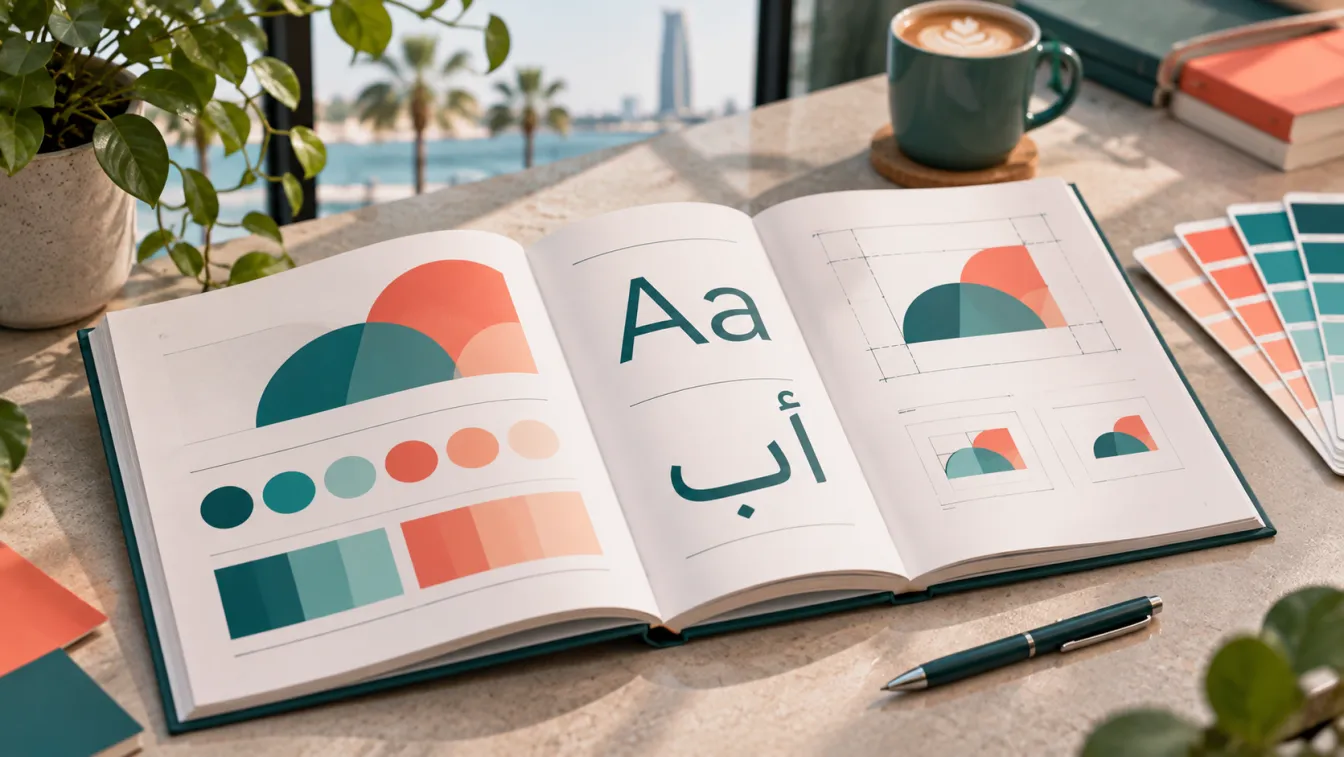
What should a healthcare brand guidelines document include?
A brand guidelines document turns the design into a system that the clinic can use consistently. Without clear guidance, different departments or external suppliers may create unrelated versions of the same brand.
A practical manual should cover:
- Brand foundation: Positioning, audience, values, personality and key messages.
- Logo rules: Approved versions, clear space, minimum sizes, backgrounds and incorrect uses.
- Colour palette: Primary and secondary colours with their digital and print specifications.
- Typography: Approved Arabic and English fonts, hierarchy and usage examples.
- Photography: Image direction, subject selection, tone, permissions and privacy considerations.
- Graphic elements: Icons, patterns, illustration style and supporting visual devices.
- Language and tone: Preferred terminology, writing principles and examples of appropriate communication.
- Applications: Examples for signage, stationery, uniforms, presentations, website pages and social media.
The document should be usable by the people who actually manage the clinic. A detailed manual that nobody can understand or access will not create consistency. Keep the rules clear and provide practical templates where repeated communication is required.
Common healthcare branding mistakes to avoid
Even a carefully designed identity can become ineffective when the strategy or implementation is weak. Watch for these common problems:
- Copying another clinic: Competitor references can help identify category conventions, but copying their colours, symbols or messaging makes your clinic less distinctive.
- Using generic medical symbols: A familiar icon is not a substitute for a recognisable identity.
- Making unsupported promises: Avoid guarantees about results, recovery, outcomes or service superiority unless claims are properly substantiated and permitted.
- Ignoring Arabic applications: A brand that works only in English is incomplete if Arabic-speaking patients are a core audience.
- Treating the website as an afterthought: Patients need accurate service and contact information, not just an attractive homepage.
- Separating marketing from operations: The experience promised in campaigns should match the experience delivered by the clinic.
- Redesigning without a clear reason: A new logo will not resolve poor service information, unclear booking steps or operational inconsistencies.
When should a clinic rebrand?
A rebrand may be appropriate when the clinic changes its name, expands into new specialities, opens additional branches, merges operations or discovers that its existing identity no longer reflects its actual positioning. It may also be worth considering when patients regularly misunderstand the services offered or when different locations present an inconsistent brand.
However, a full rebrand is not always necessary. If the clinic's positioning is sound and the identity is recognisable, a focused update may be enough. You might improve the website, refine the messaging, standardise templates or replace confusing signage while keeping the core identity.
A clinic should also avoid starting a major branding project when its service offering, ownership structure or expansion plans are still changing. Resolve those strategic decisions first. Otherwise, the identity may need to be rebuilt before it has been properly implemented.
How to approach a healthcare branding project
A disciplined project begins with discovery, not design software. The clinic and its branding team should agree on the scope, decision-makers, deliverables and approval process before production begins.
A practical sequence is:
- Discovery and audit: Review the current identity, services, audience, competitors, patient journey and existing communication materials.
- Positioning: Agree on the clinic's audience, differentiators, personality and central messages.
- Creative direction: Explore visual routes that express the agreed strategy and suit the healthcare context.
- Identity development: Refine the selected direction into a logo, colour system, typography and supporting elements.
- Real-world applications: Test the system on signage, documents, website layouts and social media templates.
- Guidelines and handover: Deliver the brand manual and organised assets, with clear instructions for internal teams and suppliers.
- Implementation review: Check how the identity performs across actual patient touchpoints and address inconsistencies.
The scope will depend on whether the clinic needs a new identity, a brand refresh or a wider experience and communication project. A short discovery conversation can clarify what is necessary before committing to a full engagement.
Work with us: If your clinic or medical centre needs a clearer position, a consistent identity or a more coherent patient-facing experience, explore branding services by LtsThink. We can help you define the strategy, develop the visual system and plan its application across your real-world and digital touchpoints. You may also find our upcoming guide to retail branding in Saudi Arabia useful when comparing how different service businesses build recognisable customer experiences.
FAQ
What is healthcare branding? Healthcare branding is the process of defining and expressing a healthcare organisation's identity through its positioning, visual design, language and patient-facing experience. It helps people understand the clinic and what to expect from its services.
Why does a clinic need a brand identity? A clear brand identity makes the clinic easier to recognise and helps it communicate its services consistently across signage, websites, documents and social media. It supports trust, but it does not replace clinical quality or professional standards.
What should a medical centre include in its brand guidelines? The guidelines should explain the brand positioning, logo use, colours, Arabic and English typography, photography, tone of voice and applications such as signage, uniforms, documents and digital templates.
Does a clinic need a complete rebrand to look more professional? Not necessarily. If the existing identity is recognisable and the positioning is still accurate, improvements to the website, messaging, templates or signage may solve the problem without replacing the entire brand.
Should healthcare branding be bilingual in Saudi Arabia? When a clinic serves both Arabic- and English-speaking audiences, it should plan for both languages from the beginning. The identity should support Arabic right-to-left layouts and readable typography while maintaining a consistent experience across languages.