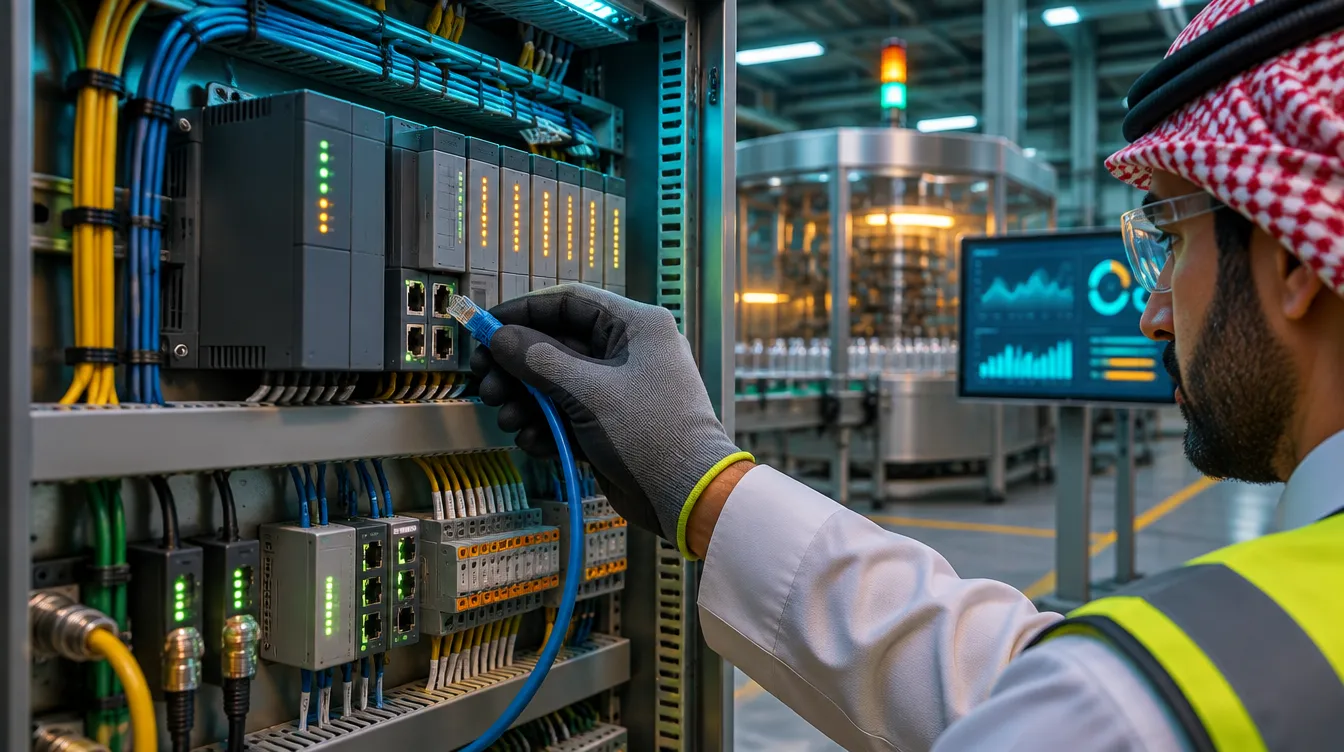
Machine data integration connects industrial equipment, PLCs and sensors with the software systems used to manage production, maintenance, quality and business operations. Instead of relying entirely on manual readings and paper production reports, a factory can collect selected machine signals, interpret them in context and make useful information available to operators, supervisors and management.
For manufacturers in Saudi Arabia, machine data integration can help connect the physical production process with a manufacturing ERP and MES solution. The goal is not to connect every machine simply because it is possible. It is to identify which equipment data supports a real operational decision, how that information should be validated and which system should use it.
What is machine data integration in manufacturing?
Machine data integration is the process of collecting, transferring and using information generated by production equipment. That information may come from programmable logic controllers (PLCs), industrial sensors, machine controllers, drives, meters, production terminals or existing supervisory systems.
A machine might expose signals showing whether it is running, stopped, in an alarm state or waiting for material. A sensor may report temperature, pressure, flow, vibration or another process value. A production controller may provide counts, cycle information or operating modes. The meaning and reliability of each signal depend on the equipment, sensor, configuration and operating environment.
The integration layer connects these sources to applications that can interpret and use the information. For example, an MES may associate machine events with a production order, while a maintenance application may use selected equipment readings to support inspection or maintenance workflows. ERP can then receive confirmed production quantities or downtime information for planning and reporting.
This is different from simply displaying a machine value on a screen. Useful integration connects a signal to the relevant machine, production line, product, order, event and business process.
How PLCs, sensors and industrial machines communicate
Most industrial equipment was designed first to control or monitor a physical process, not necessarily to exchange data with an enterprise application. Integration therefore begins by understanding the available control architecture and communication interfaces.
A PLC reads inputs, executes control logic and operates outputs according to its programmed application. It may expose selected status and process values through an industrial communication protocol or an approved gateway. Sensors provide measurements or status signals to the PLC or another control device. Machine controllers and drives may expose additional information about operating states, faults and performance.
Common technologies and interfaces include:
- OPC UA: An industrial communication standard used to exchange structured information between compatible systems and devices.
- Modbus TCP and RTU: Communication protocols commonly encountered in industrial equipment, meters and controllers.
- EtherNet/IP and PROFINET: Industrial Ethernet technologies used in automation environments.
- MQTT: A lightweight publish-and-subscribe messaging protocol that can be used to distribute selected equipment data through an integration architecture.
- Vendor-specific interfaces: APIs, gateways, data exports or communication drivers supplied for particular machine families.
- Digital and analogue signals: Basic electrical inputs and outputs that may require suitable interface hardware and engineering configuration before they can be collected safely.
Not every machine supports every protocol. Older equipment may expose only limited signals, while newer machines may provide structured data through an industrial gateway. Before selecting integration technology, review the machine documentation, PLC configuration, available network interfaces and any restrictions imposed by the equipment manufacturer.
Machine data integration architecture: from equipment to ERP and MES
A reliable architecture separates equipment control from business applications. The PLC should continue performing its intended control functions, while an appropriately designed integration layer collects approved data and passes it to systems that need it.
A common architecture includes several layers:
- Machines and sensors: Generate process measurements, machine states, alarms, counts and other signals.
- Control layer: PLCs, machine controllers and local automation systems manage equipment and expose selected information.
- Industrial gateway or edge layer: Collects data from supported interfaces, performs protocol conversion, applies basic filtering and manages communication with higher-level systems.
- Integration and messaging layer: Routes data, handles timestamps and identifiers, manages delivery and connects equipment sources with applications.
- MES and operational applications: Associate machine events with production orders, work centres, products, shifts and execution records.
- ERP and analytics: Use validated production information for inventory updates, planning, costing, maintenance coordination and management reporting.
The architecture should define which system owns each type of information. A PLC may be authoritative for a machine's immediate operating state. MES may own the production event associated with an order. ERP may own the production order and inventory transaction. Avoid allowing multiple systems to update the same record without a clear synchronisation rule.
For many factories, an edge gateway is useful because it can keep local data collection running even when the connection to central applications is temporarily unavailable. It can also reduce unnecessary traffic by sending selected events or processed values rather than every raw signal.
Which machine data should a factory collect?
The right data depends on the production process and the decisions the factory wants to improve. Collecting more signals does not automatically create better information. Begin with a defined operational question and identify the minimum reliable data needed to answer it.
Typical categories include:
- Machine status: Running, stopped, idle, setup, blocked, starved or faulted, where the equipment exposes meaningful states.
- Production counts: Total cycles, good units, rejected units, completed operations or material processed.
- Process measurements: Temperature, pressure, speed, flow, weight, humidity or other values relevant to the product and process.
- Alarms and events: Fault codes, safety-related states, operator interventions and equipment events, subject to approved access and handling rules.
- Energy and utilities: Electricity, compressed air, water, gas or other consumption readings where suitable meters are available.
- Equipment condition: Selected vibration, temperature, current or other condition indicators used in maintenance workflows.
A signal needs context to be useful. A temperature value without a machine identifier, measurement unit, timestamp or process context may be difficult to interpret. A production count without a defined reset rule or relationship to the active order may create misleading reports.
The data model should define each tag or measurement, its source, unit, expected range, sampling or event frequency, timestamp behaviour and responsible owner. It should also specify how missing, duplicated, delayed or implausible readings are handled.
Connecting machine data to MES
MES is often the main destination for machine data that relates directly to production execution. It can associate equipment events with work orders, operations, products, lines and shifts.
For example, when a production order is active, MES may receive machine counts and status events from a packaging line. It can compare reported output with the order requirement, record production progress and identify interruptions that require operator review. Where the process supports it, MES can also associate quality measurements with the relevant batch or production stage.
However, machine signals should not automatically be treated as confirmed production transactions. A counter may include test cycles, rejected units or movements that do not represent completed saleable output. The integration must define how counts are validated, reconciled and confirmed by authorised users or process rules.
MES can also provide a structured place for operators to classify downtime or production exceptions. A machine signal may indicate that a line has stopped, but it may not explain whether the cause was a material shortage, changeover, quality hold, equipment fault or planned break. Operator input and production context may still be needed.
For a deeper explanation of the responsibilities of these systems, read our guide to ERP vs MES for manufacturing.
Connecting machine data to ERP and maintenance systems
ERP usually needs a more selective view of machine information than a control or MES application. It may use confirmed production quantities, production completion status, selected downtime records or equipment-related information to support planning, inventory and costing.
For example, when MES confirms that a production operation is complete, ERP can use the approved result to update work-in-progress and finished-goods transactions. Actual output and consumption may also support production costing, subject to the company's accounting and costing rules.
Maintenance applications can use machine events and condition readings to support equipment inspections, maintenance requests or work orders. A repeated fault signal may prompt a review, while a condition measurement may be compared with thresholds established by the maintenance and engineering teams.
The integration should not automatically create a maintenance work order for every alarm. Some alarms are informational, some are temporary and others require immediate attention. Define severity, filtering, escalation and acknowledgement rules with the people responsible for equipment reliability and plant safety.
Our guide to preventive maintenance software for manufacturing explains how equipment records, maintenance schedules and work orders can be organised alongside wider manufacturing operations.
Practical use cases across manufacturing industries
The value of machine data varies by factory type and production process.
Food and beverage: Temperature, flow, mixing status, filling counts and packaging-line events may help teams understand production conditions and output. Any connection to product quality or controlled process parameters should follow the factory's approved procedures and validated measurement requirements.
Plastics and packaging: Extrusion, injection moulding, printing and converting equipment may expose cycle counts, operating states, temperatures, speeds and alarms. These records can help supervisors understand production progress and investigate process interruptions.
Metal fabrication: CNC machines, cutting equipment, presses and welding systems may provide machine status, cycle counts, programme references or selected process measurements. Integration can help associate work-centre activity with production orders and maintenance history.
Building materials: Mixers, crushers, conveyors, kilns and batching equipment may expose operating states, weights, temperatures or throughput readings. The relevant signals depend on the equipment design and the factory's process-control requirements.
Assembly and furniture: Workstations and automated equipment may provide cycle completion, station status, component counts or test results. These can be linked to work orders and product identities where the process requires traceability.
The best use case is usually a focused one: a production line where a particular reporting gap or operational question is already understood. Expand only after the data is reliable and the workflow creates value for the people using it.
Security and safety considerations
Connecting operational technology to business software creates responsibilities that must be addressed during design. A factory network may contain control systems that require high availability and carefully managed access. A poorly planned integration can introduce unnecessary traffic, expose equipment to unauthorised access or interfere with control operations.
Use a documented network architecture that separates operational technology from general business networks where appropriate. Apply access controls, secure authentication, approved remote-access procedures and network monitoring. Limit data collection to the interfaces and signals required for the use case.
Prefer read-only data collection when the requirement is monitoring or reporting. If a project needs to send commands or settings to equipment, treat that as a separate engineering and safety decision. It requires explicit approval, risk assessment, testing and controls designed by qualified automation personnel. An ERP or MES integration should not bypass machine interlocks, safety systems or the manufacturer's operating requirements.
Also plan for device replacement, software updates, backups, gateway failure and network interruption. Define how data is buffered, how missing records are identified and how systems recover without creating duplicate production transactions.
Common machine integration challenges
One challenge is inconsistent machine data. Different equipment suppliers may use different tag names, units, status definitions and communication methods. Build a standard data model that maps each machine's signals into consistent business meanings while preserving the original source information.
Another issue is limited access to older equipment. Some machines may not expose the required values through a supported interface. A gateway, additional sensor or approved controller modification may be possible, but the options should be assessed by qualified automation engineers before work begins.
Factories can also underestimate the importance of timestamps and production context. If machine events use inconsistent clocks or are not associated with the active order, reports may show events in the wrong sequence or attribute output to the wrong production run. Establish time synchronisation and clear rules for associating signals with machines, lines, orders and shifts.
Finally, collecting too much data can make a project difficult to operate. Large volumes of raw measurements require storage, filtering, monitoring and governance. Start with the signals needed for a defined use case, then expand when the factory understands the operational and technical implications.
How to implement machine data integration
A practical implementation begins with a discovery exercise involving production, maintenance, automation, IT and management. The team should agree on the business problem before selecting protocols or dashboards.
A phased approach can include:
- Select a pilot line: Choose equipment with a clear reporting or operational requirement and manageable integration conditions.
- Inventory equipment and interfaces: Document PLCs, controllers, sensors, network connections, protocols, available tags and supplier restrictions.
- Define the data requirements: Specify the signals, units, timestamps, frequency, quality rules and intended business use.
- Design the architecture: Establish network boundaries, gateways, data routing, security, buffering and system ownership.
- Build and validate the integration: Compare collected values with machine displays and approved production records. Test missing data, duplicate events, communication failures and equipment restarts.
- Connect operational workflows: Link validated information to MES, maintenance or ERP processes and define where human confirmation is required.
- Train and expand: Train the people who use the information, review the pilot and extend the design to additional equipment when it is stable.
Do not judge the project only by whether a dashboard displays live values. Check whether the information is accurate, trusted, associated with the right production context and used in a defined operational process.
When should a factory invest?
A factory may be ready when production reporting depends heavily on manual readings, supervisors lack timely visibility into equipment status, maintenance teams need better evidence about recurring machine events, or actual production data is difficult to reconcile with ERP records.
However, not every factory needs immediate connectivity across all machines. If equipment is old, production processes are not standardised or no one has defined how the collected information will be used, begin by improving the underlying process and selecting a limited pilot. More data is not automatically better data.
For manufacturers evaluating manufacturing ERP in Riyadh or other Saudi industrial locations, machine connectivity should be considered as part of the overall system architecture. Review existing automation equipment, network conditions, cybersecurity requirements, local support capability and the business applications that will consume the information.
LtsThink designs manufacturing ERP and MES solutions that can connect business workflows with approved shop-floor data sources. The right approach may involve a targeted gateway, an MES integration, selected sensors or a broader architecture, depending on the factory's needs. Explore our manufacturing ERP and MES services or custom ERP development to understand how connected systems can fit your operation.
Work with us: LtsThink helps Saudi manufacturers connect production equipment with ERP, MES and maintenance workflows through a practical, phased approach. Explore our manufacturing ERP and MES solution and our guide to preventive maintenance software, or contact our team to discuss your machines, interfaces and production requirements.
FAQ
What is machine data integration in manufacturing?
It is the process of collecting and connecting information from machines, PLCs, sensors and industrial control systems with applications such as MES, ERP and maintenance software. The information can support production monitoring, reporting, quality workflows and equipment maintenance.
Can PLCs connect directly to ERP software?
They can in some architectures, but a direct connection is not always the best design. An industrial gateway, edge layer or MES integration can provide protocol handling, data validation, security boundaries and production context before selected information reaches ERP.
Does machine data integration require replacing old machines?
Not necessarily. Some older machines expose usable signals through existing controllers or communication interfaces. Others may need approved gateways or additional sensors. A qualified automation assessment should establish what can be collected safely and reliably.
Should a factory connect every machine at once?
Usually not. Start with a pilot line and a clearly defined operational use case. Validate data quality, security, system integration and user adoption before extending the architecture to more equipment.