

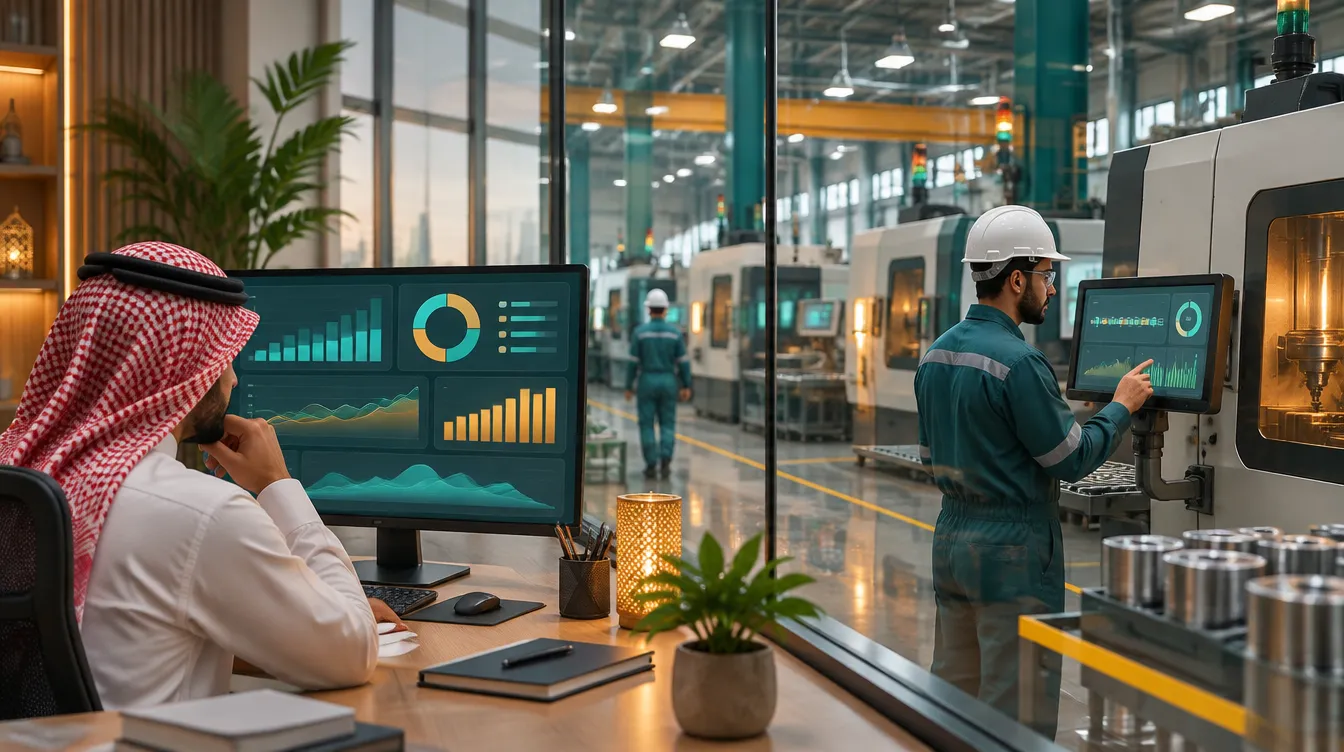
When comparing ERP vs MES for manufacturing, the most important distinction is that ERP manages business resources and transactions, while MES manages and monitors production execution on the factory floor. ERP helps coordinate purchasing, inventory, finance, sales and planning across the business. MES connects production orders to the actual work performed by machines and people during manufacturing.
They solve related but different problems. A factory may need one system, both systems integrated, or a carefully phased approach depending on its size, production model and operational requirements. Understanding the difference between ERP and MES is essential before investing in a new manufacturing ERP and MES solution.
ERP vs MES: understanding the core difference
An Enterprise Resource Planning system, or ERP, is designed to coordinate information and processes across an organisation. In a manufacturing business, it commonly manages purchasing, supplier records, inventory, bills of materials, production orders, sales, accounting, costing and management reporting.
A Manufacturing Execution System, or MES, focuses on what happens during production. It helps translate production requirements into controlled shop-floor activities, capture actual production data and provide visibility into work in progress. Depending on the implementation, it can manage dispatching, operation confirmations, material consumption, quality checks, machine status, labour records and production history.
A useful way to think about the distinction is to ask two questions:
- ERP: What does the business need, what resources are available, what should be purchased or produced, and what are the financial and inventory consequences?
- MES: What is happening on the production floor, which operation is being performed, what quantities have actually been produced, and whether the process is following the required instructions?
These responsibilities overlap at certain points. For example, ERP may create a production order and reserve materials, while MES receives the order, guides execution and sends back actual production results. The systems should exchange information without creating competing versions of the same record.
What does a manufacturing ERP system manage?
ERP provides the operational and administrative backbone of a manufacturing company. Its role is to connect departments that would otherwise maintain separate records and spreadsheets.
Typical manufacturing ERP capabilities include:
- Procurement: purchase requests, purchase orders, supplier records, approvals and receiving transactions.
- Inventory and warehouses: item master data, stock balances, warehouse locations, transfers, reservations, lot tracking and replenishment.
- Production planning: demand, production orders, bills of materials, routings, material requirements and capacity considerations.
- Finance and costing: accounts payable and receivable, general ledger, product costs, production expenses and financial reporting.
- Sales and customer orders: quotations, sales orders, delivery planning and customer information.
- Human resources: employee records, attendance, payroll and workforce administration where included in the solution.
- Management reporting: purchasing commitments, stock valuation, production costs, order status and business performance.
For example, a factory receives a customer order for a finished product. ERP can check available stock, calculate material requirements, create or propose a production order, reserve materials and coordinate purchasing for shortages. It can also connect the resulting production activity to inventory valuation and financial accounting.
ERP is therefore concerned with business-wide coordination. It needs accurate information from production, but it does not necessarily provide the detailed real-time execution controls required by every factory floor.
What does a Manufacturing Execution System manage?
MES focuses on production execution: the movement of work through manufacturing operations and the recording of what actually happens at each stage.
Depending on the factory and the chosen architecture, MES capabilities may include:
- Production order dispatching and work instructions.
- Operation start, pause, completion and quantity confirmation.
- Work-in-progress tracking across lines and work centres.
- Actual material consumption, substitutions and production returns.
- Labour or operator activity records where required.
- Machine status, downtime reasons and production events.
- In-process inspections and quality checkpoints.
- Scrap, rework and nonconformance recording.
- Production genealogy and batch or serial traceability.
- Production dashboards and operational performance monitoring.
Consider a factory producing several orders on the same line. ERP may issue the orders and define the required products and quantities. MES can present the relevant work instructions, record which order is running, capture quantities completed and document rejected units or process interruptions.
This difference matters because planned production and actual production are not always identical. A system that only records planned quantities may not explain material variances, rework, rejected output or the actual sequence of operations. MES can provide a more detailed execution record when the factory needs that level of control.
ERP vs MES: a practical comparison
The distinction becomes clearer when comparing the questions each system is designed to answer.
- Customer demand: ERP responsibility: Sales orders and demand planning. MES responsibility: Production execution against released orders.
- Materials: ERP responsibility: Purchasing, stock balances and reservations. MES responsibility: Actual material use and consumption confirmation.
- Production orders: ERP responsibility: Creation, planning and business status. MES responsibility: Dispatching, operation tracking and execution status.
- Work in progress: ERP responsibility: Inventory and order-level visibility. MES responsibility: Detailed tracking through production stages.
- Quality: ERP responsibility: Quality-related business records and supplier processes. MES responsibility: In-process checks and production-linked results.
- Machines: ERP responsibility: Asset and maintenance-related business records. MES responsibility: Production status and machine-event capture when integrated.
- Costing: ERP responsibility: Financial and inventory valuation. MES responsibility: Actual production quantities, time and consumption data for costing.
- Traceability: ERP responsibility: Lot and serial records across purchasing and inventory. MES responsibility: Production genealogy and relationships between inputs and outputs.
This is a functional comparison, not a rule that every ERP or MES product includes exactly the same features. Some ERP platforms offer shop-floor modules, while some MES products include scheduling, quality or maintenance capabilities. The actual boundary depends on the software and how it is configured.
ERP vs MES: do you need one or both?
The answer depends on the problems the factory needs to solve. Buying both systems is not automatically the best decision. A business should identify its operational gaps before choosing an architecture.
ERP may be the right first step when:
- Purchasing, inventory, finance and sales use disconnected systems.
- Material availability is difficult to confirm before production.
- Production orders are not connected to bills of materials or inventory transactions.
- Management cannot reconcile stock movements with financial records.
- The business needs a consistent view across multiple warehouses, branches or production sites.
In these situations, the priority is usually to establish reliable business processes and master data. Adding a detailed MES layer before the ERP foundation is stable may introduce unnecessary integration and support work.
MES may be the priority when:
- The factory already has a working ERP but lacks detailed shop-floor visibility.
- Operators rely on paper sheets to report production progress.
- Actual consumption, output, scrap and rework are difficult to capture consistently.
- Supervisors need timely information about work centres, production stages or machine events.
- Product genealogy requires detailed links between production inputs, operations and outputs.
A factory may also need both when business planning and production execution have become separate challenges. ERP coordinates the resources and commitments of the business; MES provides the execution record needed to understand what happened during manufacturing.
How ERP and MES should work together
The value of an integrated architecture comes from clear responsibilities and reliable information exchange. The systems should not force employees to enter the same information repeatedly or maintain conflicting order and inventory records.
A typical connected workflow looks like this:
- Demand enters ERP: A customer order, forecast or replenishment requirement creates a demand signal.
- ERP plans production: The system checks material availability, bills of materials, routings and relevant planning constraints before creating or releasing production orders.
- MES receives released work: The production order, product specification, required quantity and relevant instructions are sent to the shop floor.
- Production executes the order: Operators record operation progress, material consumption, output, quality checks, scrap and rework through the MES workflow.
- MES reports actual results: Completed quantities, material usage, production status and relevant exceptions are sent back to ERP.
- ERP updates business records: Inventory, order status, costing and financial processes use the confirmed production information.
The integration needs explicit rules. For example, the organisation should decide which system owns production-order creation, which system controls material reservations, where actual consumption is confirmed and how finished goods are received into inventory.
Integration can use APIs, middleware, message queues or other supported interfaces. The right approach depends on the products involved, data volumes, network conditions and the need for near-real-time updates. A factory should also plan for temporary connection failures, duplicate messages and corrections to previously submitted transactions.
How does this apply to different factory types?
The right balance between ERP and MES varies with the production model.
Food and beverage manufacturing: ERP can manage purchasing, recipes or bills of materials, inventory, production orders and costing. MES may capture batch execution, ingredient consumption, process checks, production parameters and packaging activities. The level of detail depends on the process and the manufacturer's quality requirements.
Plastics and packaging: ERP can coordinate resin and packaging procurement, stock, production requirements and sales orders. MES may provide visibility into extrusion, injection moulding, printing or converting operations, including machine events, output and rejected quantities.
Metal fabrication and building materials: ERP can manage raw materials, purchase commitments, project or customer demand and production costing. MES may track cutting, forming, machining, casting or other work-centre operations, including actual output and relevant material references.
Furniture and assembly: ERP can coordinate components, purchased parts, bills of materials and order fulfilment. MES may guide assembly steps, record component consumption, track work in progress and associate quality checks with specific orders or serialised products.
Process and chemical manufacturing: ERP can manage procurement, inventory, production requirements and financial records. MES may capture batch execution, process values, operator confirmations and production genealogy where the plant needs detailed operational records. Machine and control-system integration must be designed with the plant's engineering and safety requirements in mind.
For a broader look at the role of production scheduling and material planning, see our guide to production planning software.
Can one platform provide both ERP and MES capabilities?
Yes, but the phrase "all-in-one" does not guarantee that every production requirement is covered. Some platforms combine business management with shop-floor execution modules. Others provide a manufacturing ERP and integrate it with a specialist MES. A custom platform may also combine both layers where the factory has specific workflows that standard products cannot handle cleanly.
When assessing a single platform, ask whether it supports the required execution detail rather than relying on a feature list. Can operators record production at the operation level? Can the system capture actual material consumption and rework? Does it support the required machine connections? Can it preserve batch genealogy? Are production records available quickly enough for supervisors?
Also consider usability. A finance team, planner, warehouse operator and machine operator have different tasks and working environments. One platform can provide a shared data model while presenting different interfaces and permissions for each role.
A custom solution should not be selected simply because the organisation wants one supplier or one login. It should be justified by process requirements, integration needs, long-term ownership and the ability to maintain the system as the factory changes.
Common ERP vs MES implementation mistakes
One mistake is buying MES before documenting the production process. If routings, work centres, product structures and production reporting rules are unclear, the project may automate inconsistent practices.
Another is expecting ERP to provide detailed machine-level visibility without checking its actual capabilities. A production order screen is not the same as a shop-floor execution workflow, and a planned completion date is not proof of actual output.
Factories can also create unnecessary complexity by implementing too many modules at once. A phased rollout is often easier to manage: establish core ERP transactions, stabilise production planning and inventory, then add MES capabilities where execution visibility is needed.
Finally, do not underestimate integration ownership. Decide who is responsible for item data, production orders, machine interfaces, user access, data corrections and system monitoring. Without clear ownership, the two systems can become separate sources of conflicting information.
An ERP vs MES roadmap for Saudi manufacturers
Start with a review of the current operating model. Map how customer demand becomes a production order, how materials are purchased and issued, how work moves across production stages, and how finished goods are approved and dispatched.
Then identify the gaps that matter most. If stock and purchasing are unreliable, stabilise ERP processes first. If the business records orders correctly but cannot see what is happening on the production floor, assess MES requirements. If both areas need improvement, define a shared target architecture and implement it in manageable releases.
For manufacturers in Riyadh, Jeddah and other industrial centres, the right system should reflect the actual factory process rather than a generic demonstration workflow. Review Arabic and English interfaces, local accounting and invoicing requirements, warehouse operations, production-floor connectivity, data ownership and support arrangements.
A useful evaluation should include a real production scenario from order creation to finished-goods receipt. Ask the vendor or implementation team to demonstrate planned materials, actual consumption, production progress, quality records, rejected quantities and the resulting inventory and costing updates.
LtsThink designs manufacturing systems around the processes that factories need to manage. Our approach can include ERP, MES, integrations and shop-floor interfaces, with a phased implementation plan based on the factory's priorities. Learn more about our manufacturing ERP and MES services or review our approach to custom ERP development.
Work with us: If your factory is weighing ERP vs MES or an integrated platform, LtsThink can help map the processes, define system responsibilities and plan a practical rollout, whether you need manufacturing ERP in Riyadh, Jeddah or elsewhere in the Kingdom. Explore our manufacturing ERP and MES solution and our guide to production planning software, or contact our team to discuss your requirements.
FAQ
Is ERP the same as MES?
No. ERP coordinates business processes such as purchasing, inventory, finance and production planning. MES focuses on production execution, including work instructions, operation tracking, actual output, material consumption and shop-floor records.
Can a factory use MES without ERP?
Yes, in some cases. A factory may use MES alongside existing business applications or manual processes. However, it needs reliable ways to exchange production orders, material information and completed output with the systems managing inventory and business transactions.
Does every manufacturing company need both ERP and MES?
No. The right choice depends on production complexity and the problems the business needs to solve. Some factories need a connected ERP foundation first, while others already have ERP and need more detailed production execution visibility.
Should ERP or MES be implemented first?
If purchasing, inventory, finance and production planning are fragmented, ERP is often the logical starting point. If those processes are already controlled but shop-floor execution is poorly recorded, MES may be the next priority. A combined programme should still use phased releases and clear ownership of shared data.