

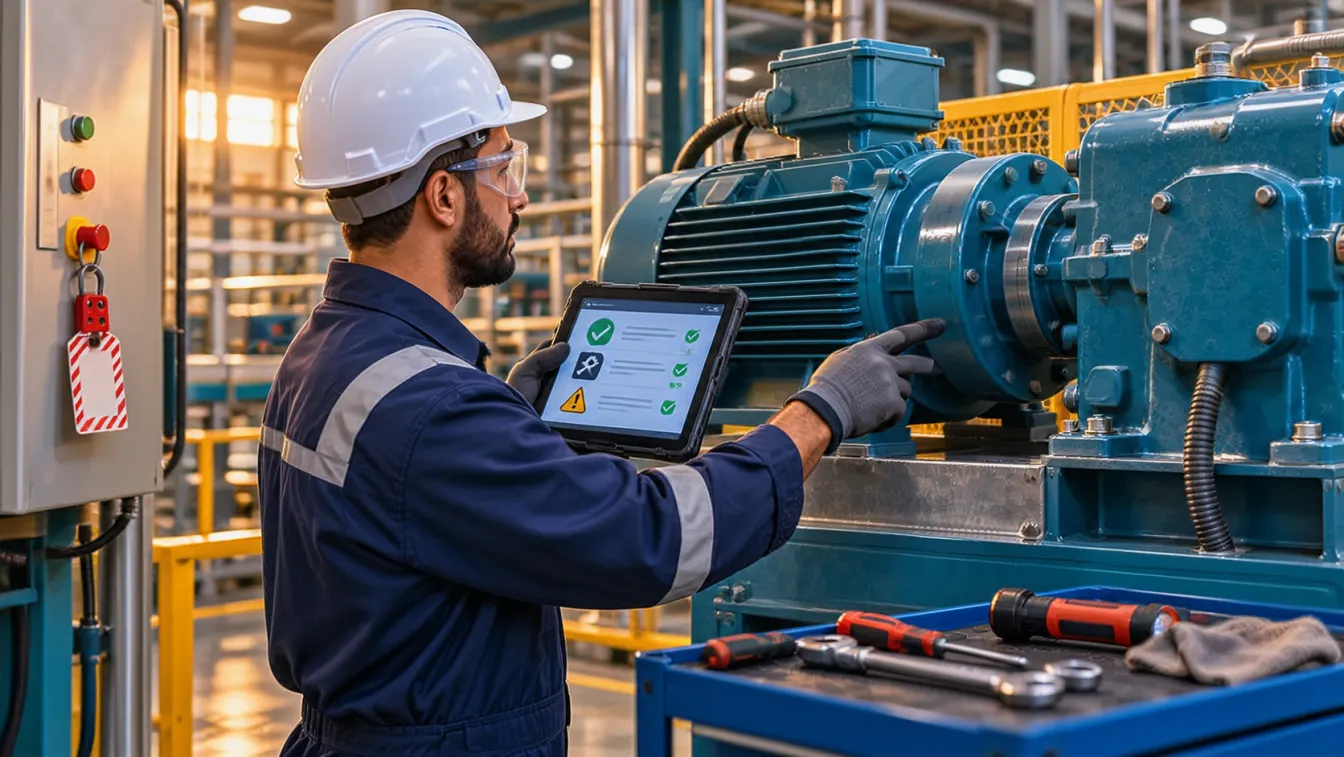
Preventive maintenance software helps manufacturing companies plan equipment inspections, schedule routine servicing, manage maintenance work orders and record machine history before unexpected failures disrupt production. Instead of waiting for equipment to break down, factories can organize maintenance activities around operating hours, production schedules and manufacturer recommendations.
For Saudi factories operating production lines, processing equipment, compressors, pumps and industrial machinery, preventive maintenance software should connect maintenance teams with production, inventory and purchasing. This gives plant managers a clearer understanding of equipment condition, upcoming maintenance requirements, spare parts availability and the operational impact of maintenance decisions.
Why preventive maintenance matters in manufacturing
When a factory depends on equipment to meet customer orders, an unexpected machine failure can affect much more than the maintenance department. It may interrupt production, delay deliveries, increase repair expenses and create pressure on other production lines.
Many factories still manage maintenance through spreadsheets, paper forms, phone calls or informal instructions. These methods become difficult to control when equipment increases, multiple shifts operate or maintenance activities need to be coordinated across departments.
Common problems include:
- Maintenance being performed only after a machine fails.
- Inspection schedules being missed or recorded inconsistently.
- Equipment history being spread across paper files and individual spreadsheets.
- Production supervisors not knowing when machines are due for maintenance.
- Spare parts being unavailable when technicians need them.
- Repeated equipment failures without a clear record of previous repairs.
- Maintenance costs being recorded without connecting them to individual machines.
- Technicians receiving incomplete descriptions of reported equipment problems.
These problems reduce management's ability to plan maintenance work and understand the reliability of production assets.
An integrated manufacturing ERP system in Saudi Arabia can connect maintenance activities with production schedules, inventory transactions and financial records rather than treating maintenance as an isolated department.
What preventive maintenance software should manage
A useful maintenance system should provide a structured record of factory equipment and the activities required to keep it operational.
1. Equipment and asset register
The foundation of maintenance management is an accurate equipment register.
Each machine or maintainable asset should have a record containing relevant information such as:
- Equipment code and description.
- Manufacturer, model and serial number.
- Factory, building and production-line location.
- Installation and commissioning information.
- Technical specifications and operating instructions.
- Warranty and supplier information where applicable.
- Maintenance responsibility and assigned team.
- Criticality and operational priority.
The equipment register should reflect the factory's actual asset structure. A production line may contain several machines, motors, pumps, conveyors and supporting components, each with different maintenance requirements.
A clear hierarchy helps maintenance managers understand which assets belong to which production areas and identify equipment that requires attention.
2. Preventive maintenance schedules
Preventive maintenance is based on planned activities performed before a known or anticipated equipment problem causes failure.
Maintenance schedules can be triggered by:
- Calendar intervals, such as weekly or monthly inspections.
- Equipment operating hours.
- Production cycles or completed operations.
- Manufacturer maintenance recommendations.
- Inspection findings and maintenance history.
- Specific operating conditions defined by the factory.
For example, a factory may schedule lubrication, filter replacement, belt inspection and electrical checks according to equipment requirements.
The system should generate upcoming maintenance tasks, identify overdue work and make responsibilities clear to technicians and supervisors.
Schedules should remain configurable because not every machine requires the same maintenance interval. The maintenance team should determine appropriate tasks using operating conditions, equipment documentation and actual maintenance history.
3. Maintenance work orders
A maintenance work order defines the work that needs to be performed, the equipment involved and the resources required.
A complete work order should include:
- Equipment identification and location.
- Maintenance type and reported problem.
- Description of the required work.
- Priority and target completion date.
- Assigned technician or maintenance team.
- Required spare parts and tools.
- Safety instructions and relevant procedures.
- Work performed and inspection results.
- Actual labour time and materials consumed.
- Completion approval and maintenance notes.
Work orders may be generated automatically from preventive schedules or created when operators report an equipment problem.
A controlled approval process also helps maintenance managers prioritize urgent work and coordinate machine availability with production supervisors.
Reactive, preventive and condition-based maintenance
Factories should understand the difference between maintenance approaches before deciding which processes to automate.
Reactive maintenance
Reactive maintenance takes place after equipment fails or develops a problem requiring repair.
It may be reasonable for non-critical assets where failure has limited operational consequences and preventive servicing would not be justified. However, relying entirely on reactive repairs for critical production equipment exposes the factory to avoidable operational uncertainty.
Preventive maintenance
Preventive maintenance uses planned inspections and servicing to address known maintenance requirements before equipment failure occurs.
It is appropriate for machines with documented maintenance needs, predictable wear patterns or operating requirements that call for regular inspection.
The system helps ensure that maintenance tasks are scheduled, assigned, recorded and reviewed.
Condition-based maintenance
Condition-based maintenance uses information about actual equipment condition to determine when maintenance should be performed.
Depending on the equipment, this information may include:
- Vibration readings.
- Temperature measurements.
- Pressure readings.
- Motor current and operating conditions.
- Lubricant condition.
- Inspection observations.
A factory may use sensors, inspection instruments or operator observations to identify changes that require investigation.
Condition-based maintenance should not be confused with predictive maintenance. Predictive approaches require a suitable data history and analytical methods to estimate equipment failure or maintenance needs. Not every factory has the sensors, data quality or operational maturity required for this approach.
How preventive maintenance software connects with ERP and production
Maintenance should not operate independently from production planning and inventory management.
When maintenance is scheduled, the system should help determine whether the machine can be taken out of service without creating unnecessary disruption to production commitments.
An integrated ERP and CMMS environment can connect:
- Equipment availability with production scheduling.
- Planned maintenance with production calendars.
- Maintenance work orders with technician assignments.
- Spare parts requirements with warehouse inventory.
- Purchase requests with procurement workflows.
- Maintenance expenses with accounting records.
- Machine downtime with production reporting.
For example, if a production line has scheduled maintenance, the production planner should be able to review affected orders and coordinate alternative equipment or revised production sequences where possible.
Similarly, when a technician needs a replacement motor or bearing, the maintenance work order should connect with spare parts inventory. If the required component is unavailable, the system can support a purchasing request rather than leaving the technician to search manually across departments.
This is where manufacturing inventory management in Saudi Arabia becomes particularly relevant. Spare parts and maintenance materials need the same disciplined stock control as production materials, with appropriate reservations and issuing procedures.
Connecting maintenance with MES and machine data
A Manufacturing Execution System (MES) can provide useful information about actual machine activity.
Depending on the factory's equipment and integration capabilities, this may include operating hours, machine states, stop events, production cycles and selected sensor readings.
Connecting this information to maintenance records can help teams:
- Compare actual operating hours with maintenance schedules.
- Identify recurring stop events.
- Record machine downtime against specific equipment.
- Review the maintenance history associated with production interruptions.
- Coordinate servicing with actual equipment usage.
Not every machine supports direct integration. Some equipment may require a gateway, controller interface or manual data entry. The integration design should be based on the available equipment documentation and technical access.
Building a practical maintenance workflow
A maintenance system should make it easy to move from identifying a maintenance need to completing and reviewing the work.
A typical workflow includes:
- Register equipment and define its maintenance requirements.
- Create preventive schedules based on approved intervals or operating conditions.
- Generate maintenance work orders when tasks become due.
- Assign technicians and check spare parts availability.
- Coordinate machine access and maintenance timing with production.
- Perform the maintenance and record actual work, parts and observations.
- Complete the inspection and obtain the required approval.
- Update equipment history and schedule the next activity.
For breakdown maintenance, operators should also have a simple way to report problems, attach photographs where appropriate and identify the affected machine.
The maintenance manager can then assess the issue, assign priority and determine whether the equipment should remain operational or be isolated according to the factory's safety procedures.
Maintenance checklists and technical documentation
Maintenance activities should not depend entirely on individual technicians remembering what needs to be checked.
Digital checklists can standardize inspections and record the results of recurring tasks.
Depending on the equipment, a checklist may include lubrication condition, unusual noise, temperature, pressure, visible leakage, guards, electrical connections and other manufacturer-recommended checks.
The system should also provide access to equipment manuals, technical drawings, inspection instructions and previous maintenance reports.
Safety procedures must remain aligned with the factory's approved requirements. Software records support the process but do not replace competent inspection, isolation procedures or technician training.
Maintenance KPIs and equipment performance reporting
Management needs useful indicators to understand how maintenance activities affect production operations.
A maintenance dashboard may include:
- Planned maintenance tasks completed and overdue.
- Open maintenance work orders by priority.
- Equipment downtime and recorded reasons.
- Repeated failures by machine or component.
- Maintenance labour hours.
- Spare parts consumption.
- Maintenance expenses by asset or department.
- Mean time between failures (MTBF), where reliable failure records are available.
- Mean time to repair (MTTR), where repair timestamps are consistently recorded.
These indicators should be interpreted in context. A high number of work orders does not automatically mean poor maintenance performance, and a machine with limited recorded downtime may simply have incomplete reporting.
The purpose of reporting is to identify recurring problems, understand maintenance workload and support decisions about equipment condition, replacement, servicing and production planning.
Choosing preventive maintenance software in Saudi Arabia
When evaluating a maintenance system, plant managers should assess how well it supports the factory's actual equipment, maintenance procedures and production environment.
Ask potential providers:
- Can the system manage machines, equipment components and asset locations?
- Can maintenance schedules be based on time, operating hours or production cycles?
- Does it automatically generate preventive maintenance work orders?
- Can technicians access tasks and equipment history through tablets?
- Does it support spare parts reservations and warehouse integration?
- Can maintenance be coordinated with production scheduling?
- Can it record equipment downtime and maintenance costs?
- Does it support condition readings and inspection checklists?
- Can it integrate with existing ERP systems and available machine interfaces?
- Does it support Arabic-first and bilingual workflows?
Factories searching for manufacturing ERP in Riyadh or manufacturing ERP in Jeddah should consider whether the proposed provider can understand the factory's equipment structure, operating conditions, maintenance responsibilities and production priorities.
A custom ERP and CMMS approach can be useful when the factory needs maintenance workflows that existing software cannot represent adequately. However, replacing a functioning maintenance application may not be necessary if integration can connect it to production and inventory systems.
When should a factory invest in a maintenance management system?
A new maintenance system may be appropriate when equipment history is incomplete, preventive tasks are frequently missed, spare parts are difficult to locate or maintenance activities cannot be coordinated with production.
Before implementation, management should establish:
- An accurate equipment register.
- Clear equipment ownership and maintenance responsibilities.
- Basic preventive maintenance procedures.
- Defined work order priorities and approval rules.
- Reliable records of breakdowns and completed maintenance.
- A spare parts classification and inventory process.
- Agreed procedures for coordinating maintenance with production.
If the factory does not know which equipment it owns or who is responsible for maintaining it, buying advanced software is unlikely to solve the underlying problem.
A small factory with simple equipment and limited maintenance requirements may initially manage its work using a structured maintenance register and basic scheduling procedures. A full CMMS may be unnecessary until the equipment base, work order volume or coordination requirements justify it.
Implementation scope depends on the number of assets, equipment hierarchy, maintenance procedures, technician access, spare parts integration, machine connectivity, reporting and historical maintenance data.
At خلينا نفكر, custom Manufacturing ERP and MES projects begin with understanding the factory's actual operating and maintenance processes. A discovery visit helps define the requirements, after which a fixed-price proposal can be prepared.
A phased implementation can start with the equipment register, preventive schedules and work orders, then introduce spare parts integration, downtime reporting, machine connectivity and more advanced maintenance analytics.
The objective is not to create more maintenance paperwork. It is to give the factory a controlled way to plan equipment care, understand recurring failures and coordinate maintenance with production.
Work with us: Explore custom Manufacturing ERP and MES solutions in Saudi Arabia to discuss a maintenance management system connected to your factory's production and inventory workflows. You can also read our guide to manufacturing inventory management in Saudi Arabia to understand how spare parts and maintenance materials should be controlled.
FAQ
What is preventive maintenance software?
It is software that helps factories schedule inspections and servicing, create maintenance work orders, manage spare parts and maintain equipment history before unexpected failures disrupt operations.
What is the difference between preventive and reactive maintenance?
Preventive maintenance is planned before equipment failure, using schedules and defined inspection requirements. Reactive maintenance takes place after a machine develops a fault or stops operating.
Can maintenance software connect with manufacturing ERP?
Yes. A connected solution can link equipment maintenance with production scheduling, spare parts inventory, purchasing, machine downtime and accounting records.
Does every factory need a CMMS?
No. A small factory with simple equipment and manageable maintenance activities may initially use structured registers and scheduling procedures. A dedicated CMMS becomes more useful as equipment, work orders and coordination requirements become more complex.
Can preventive maintenance be triggered by machine operating hours?
Yes. Where operating-hour data is available and reliable, the system can generate maintenance tasks when equipment reaches an approved operating threshold. This may require integration with machine controllers or another method of recording operating hours.