

In industrial markets, buyers are not choosing a product based on appearance alone. They are evaluating technical capability, reliability, production capacity, quality processes, delivery expectations and the confidence they have in the supplier. Effective industrial branding brings these signals together into a clear B2B identity that helps manufacturers explain what they do and why a prospective customer should consider them.
For Saudi manufacturers, a strong brand is more than a logo on a factory gate or a catalogue cover. It is a consistent way to communicate capabilities across sales meetings, tenders, technical documents, websites, exhibitions and everyday business interactions. A clear brand strategy gives that communication a direction before visual design begins.
Why industrial branding matters in B2B markets
Industrial purchasing often involves several decision-makers. Procurement teams may compare suppliers, engineers assess specifications, operations managers consider production reliability, and executives evaluate commercial and strategic fit. Each stakeholder needs clear, relevant information.
A coherent industrial brand helps a manufacturer:
- Explain its capabilities: Make products, processes, industries served and technical strengths easier to understand.
- Build recognition: Present a consistent identity across facilities, digital channels, documents and events.
- Support sales conversations: Give sales teams structured messages and professional materials.
- Communicate credibility: Show evidence of capability through accurate information, certifications where applicable, and clearly explained processes.
- Differentiate responsibly: Explain genuine strengths without relying on unsupported claims about being the largest, fastest or best.
- Align the organisation: Help management, sales, engineering and customer service communicate a consistent business proposition.
A brand cannot replace product quality, operational discipline or customer service. It can, however, make those strengths easier to recognise and evaluate.
Industrial branding starts with positioning
Before designing a logo or selecting a colour palette, define the manufacturer's position in the market. A company that produces industrial packaging has a different value proposition from a manufacturer of electrical components, construction materials or specialised machinery.
Start with these questions:
- Which markets do you serve? Identify the industries, applications and customer types that matter most. Avoid describing the company as serving every industry if its actual capabilities are more focused.
- What do you manufacture? Clarify the product categories, materials, processes and levels of customisation you provide.
- What problems do you solve? Consider whether customers rely on you for consistent supply, specialised production, technical support, custom specifications or local manufacturing.
- What can you prove? Identify relevant evidence such as production capabilities, documented quality procedures, technical specifications, facility information and applicable certifications.
- Why should buyers remember you? Define a concise positioning statement that connects your capabilities with the needs of your intended customers.
For example, a hypothetical manufacturer of industrial components may position itself around application-specific production and responsive technical coordination. A building-materials manufacturer may focus on product consistency, clear specifications and dependable supply arrangements. These are possible strategic directions, not claims to use without operational evidence.
Your positioning should be specific enough to guide the website, sales presentation and visual identity. If your business has several product divisions, it should also clarify how those divisions relate to the parent company. Our brand strategy service can help structure that thinking before the design stage.
Define the industrial brand architecture
Manufacturers sometimes operate under one company name with several product ranges, factories, divisions or specialist business units. Without a clear architecture, customers may struggle to understand which entity makes a product, who handles enquiries or how different offerings relate.
Choose an architecture that reflects the real organisation:
- One master brand: Use the corporate brand across the company and its product categories when a unified reputation is the priority.
- Endorsed product brands: Give a product line its own identity while making its relationship to the parent company visible.
- Separate business brands: Consider distinct brands when business units serve substantially different markets or have genuinely different propositions.
Do not create a separate brand for every product simply because it has a different specification. More brands create more work: each needs messaging, design assets, website content, sales materials and ongoing management. The structure should make the business easier to understand, not more complicated.
Build a visual identity that reflects industrial capability
Industrial design does not have to look generic or overly technical. It should express the manufacturer's character while remaining practical across factory environments, technical documents, product labels, digital interfaces and corporate materials.
Logo and brand recognition
A strong industrial logo should be recognisable, adaptable and easy to reproduce. Avoid details that disappear when the logo is printed on a small label, engraved on a component or applied to workwear.
Evaluate the logo in real situations:
- Does it remain clear at small sizes and from a distance?
- Can it work in one colour for stamps, labels and technical drawings?
- Is it legible on machinery, packaging, vehicles and factory signage?
- Does it feel appropriate for the company's products and target industries?
- Is it visually distinctive from competitors and existing registered marks?
Symbols based on gears, factories, hexagons and abstract engineering forms are common in industrial categories. They can be useful when developed thoughtfully, but they should not replace a distinctive concept grounded in the company's positioning.
Colour and typography
Choose colours that support recognition and work reliably in physical and digital applications. A dark technical palette may suit one manufacturer, while another may need a brighter system that reflects a focus on materials, sustainability or modern production. There is no universal industrial colour scheme.
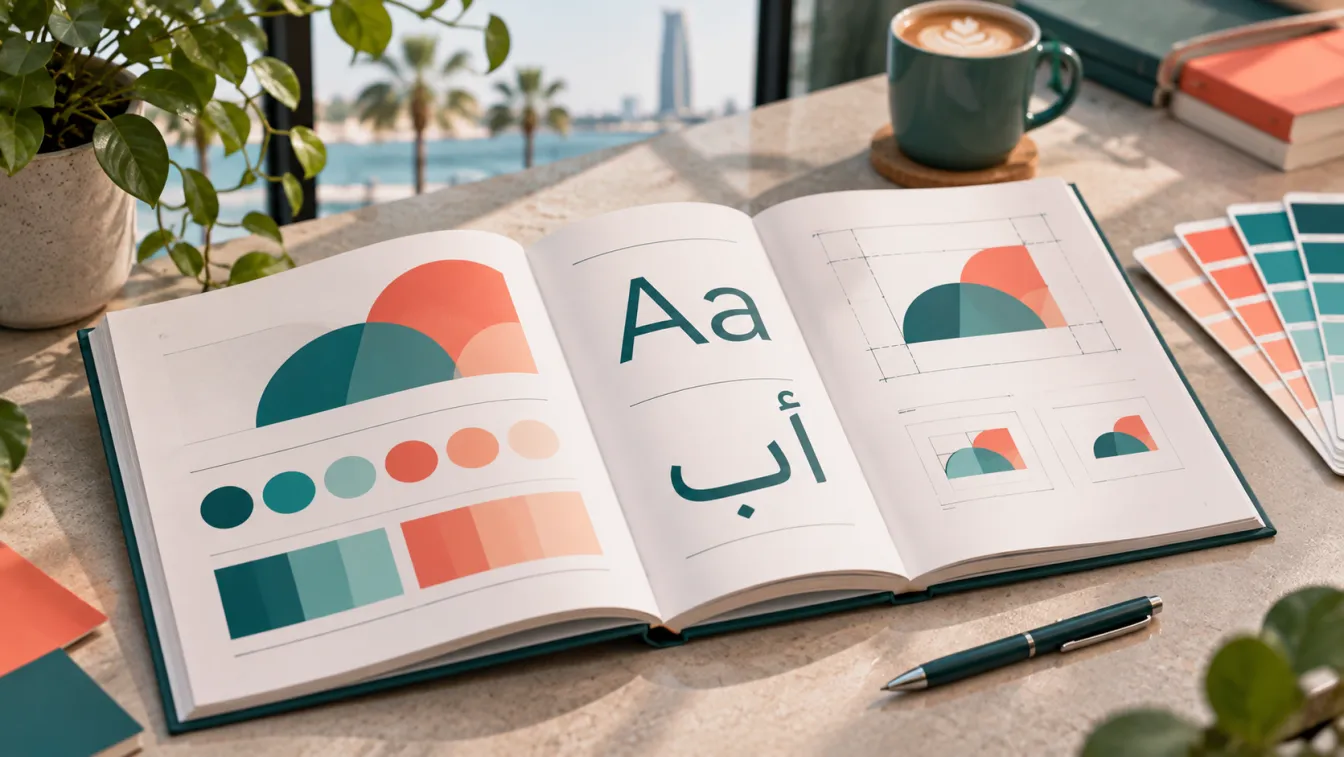
Typography should prioritise readability. Product catalogues, specifications, labels and presentations often contain dense information, so choose typefaces and layouts that make headings, measurements and descriptions easy to scan. If the business communicates in Arabic and English, test both scripts together rather than treating Arabic as a last-minute translation.
Photography and graphic language
Use authentic images of facilities, production processes, products, people and equipment where appropriate. Photography should communicate the actual environment and capabilities of the manufacturer. Avoid stock images of machinery that the company does not own or operate.
A consistent graphic language can also help explain complex products. Diagrams, process illustrations, technical icons and product-detail layouts should follow shared rules so customers can recognise the company across different materials.
Turn technical capabilities into clear brand messages
Industrial companies often know their products in great detail but struggle to explain their value to different audiences. A technical specification may be essential to an engineer, while a procurement manager needs to understand supply arrangements, documentation and commercial terms.
Build messaging around the questions buyers actually ask:
- What products or services do you provide?
- Which industries and applications do you support?
- What materials, processes or customisation options are available?
- What technical information can you share?
- How can a buyer request a quotation, sample or technical discussion?
- What quality systems, certifications or approvals can you accurately document?
Create a message hierarchy rather than using the same paragraph everywhere. The website can introduce the business and its capabilities. Product pages can explain specifications and applications. A company profile can describe facilities and operations. Sales presentations can focus on a particular customer's requirements.
Avoid empty phrases such as "world-class quality" unless you can explain what they mean and substantiate the claim. Specific information is more useful than exaggerated language.
Make the website a practical B2B sales tool
For many buyers, the website is where they check whether a manufacturer is relevant before contacting its sales team. It should answer practical questions quickly and make the next step clear.
A useful industrial website may include:
- A clear company introduction and overview of manufacturing capabilities.
- Product and service pages organised around buyer needs.
- Industry or application pages that explain where products are used.
- Technical downloads, specifications and product documentation where available.
- Facility and production information that accurately represents operations.
- Quality, certification and compliance information that is current and properly authorised for publication.
- Contact details and a clear quotation or technical enquiry process.
- Arabic and English content where both languages serve the intended markets.
Organise products so visitors can browse by category, material, application or another meaningful attribute. Do not make users search through long PDF catalogues just to identify whether a product exists.
The design should support usability on desktop and mobile. Technical documents should be easy to find, contact forms should request relevant information without becoming unnecessarily complicated, and product claims should match approved company information. A coordinated website development approach can connect the brand system with these functional requirements.
Industrial branding in the Saudi market
Saudi manufacturers operate in a business environment where local presence, supplier relationships, technical capability and clear communication can all influence how buyers assess a company. The brand should explain what the manufacturer produces, where it operates and which markets it can realistically serve.
Arabic and English communication may both be important. Build a bilingual identity that handles right-to-left Arabic layouts correctly and keeps technical terminology consistent across languages. Product names, units, specifications and safety information should be reviewed by people who understand the relevant technical context. Literal translation is not always enough.
Location messaging should also be accurate. A manufacturer based in Dammam may serve customers across the Eastern Province and other regions, while a facility in Jeddah may have a different distribution and service footprint. A branding agency in Riyadh should understand the need to communicate industrial capabilities to business buyers, just as a branding agency in Jeddah should consider the manufacturer's actual location, markets and operating model. Do not imply that a company has factories, warehouses or service coverage in locations where it does not operate.
Where relevant, manufacturers should ensure that published information about product standards, certifications, safety, environmental claims and regulatory approvals is accurate and authorised. Requirements vary by product and activity. Consult the applicable Saudi authorities, certification bodies and qualified legal or technical advisers before making claims about compliance. A branding project should organise and communicate verified information, not invent approvals or interpret technical obligations without the right expertise.
Create a consistent brand across sales and operations
The identity must work beyond the marketing department. Buyers may encounter the company through a quotation, delivery note, product label, technical drawing, exhibition stand, vehicle or email from a sales representative. Each touchpoint contributes to the overall impression.
Prioritise the materials that customers and partners use most often:
- Company profile and corporate presentation.
- Product catalogues and technical data sheets.
- Quotations, proposals and tender submissions.
- Product labels, packaging and identification systems.
- Factory signage, reception areas and safety communication.
- Exhibition graphics, banners and promotional materials.
- Email signatures, document templates and digital sales assets.
Not every operational document needs elaborate design. The goal is a recognisable and readable system that makes important information easy to find. Safety instructions and technical details must remain accurate and clear; visual styling should never interfere with their purpose.
Common industrial branding mistakes
Several avoidable mistakes can weaken an otherwise promising industrial identity:
- Looking like every other manufacturer: Reusing familiar industrial symbols and generic slogans without a clear positioning makes recognition harder.
- Using vague capability claims: Statements about quality, capacity or technical leadership should be supported by accurate evidence.
- Designing only for the website: The identity must also work on products, facilities, documents and sales materials.
- Ignoring technical buyers: A polished brand cannot compensate for missing specifications or unclear product information.
- Creating too many sub-brands: Unnecessary divisions and product identities increase complexity and weaken consistency.
- Treating Arabic as an afterthought: Poor bilingual layouts can make important information difficult to use.
- Using inaccurate photography: Images should represent real facilities, products and processes rather than an imagined operation.
When should a manufacturer rebrand?
A manufacturer may need a rebrand when it enters new industries, changes its product portfolio, expands its manufacturing capabilities, consolidates business units or discovers that its current identity no longer reflects the company it has become.
A rebrand may also be useful when several acquired or developed product lines have inconsistent identities, or when customers cannot understand the relationship between the corporate name and the products they buy.
However, a complete rebrand is not always the right answer. If the company has a recognisable identity and a clear position, it may only need a refreshed visual system, better product architecture, updated sales materials or a more useful website. If manufacturing operations, ownership or product strategy are still changing, settle those decisions first. Otherwise, the new brand may become outdated before implementation is complete.
How to approach an industrial branding project
A structured project helps keep strategy, design and implementation connected. Agree on the business objectives, decision-makers, deliverables and approval process before starting creative work.
A practical sequence includes:
- Brand and market audit: Review the current identity, product portfolio, customer groups, competitors, sales materials and digital presence.
- Positioning workshop: Define the manufacturer's markets, capabilities, differentiators, brand personality and key messages.
- Brand architecture: Decide how the corporate brand, divisions and product ranges should relate.
- Creative direction: Develop visual concepts that reflect the positioning and work in industrial applications.
- Identity development: Finalise the logo, colour system, typography, graphic elements and core templates.
- Sales and operational applications: Apply the identity to the website, company profile, product materials, quotations, signage and exhibition assets.
- Guidelines and rollout: Deliver organised files, practical usage rules and an implementation plan for internal teams and suppliers.
The scope depends on the manufacturer's situation. A business with one established product range may need a focused identity update, while a group with multiple divisions may need a broader positioning and architecture project. A discovery discussion can help identify the right level of work before committing to a full engagement.
Work with us: If your manufacturing business needs a clearer B2B position, a stronger corporate identity or consistent communication across products and sales channels, explore our brand strategy services. We can help define your positioning, organise your brand architecture and develop a practical identity system for your business. You can also explore our guide to brand architecture in Saudi Arabia for a deeper look at structuring multiple brands and product lines.
FAQ
What is industrial branding? Industrial branding is the process of defining and expressing a manufacturer's identity across its positioning, visual design, messaging, products and B2B customer experience. It helps buyers understand the company's capabilities and what makes its offer relevant.
Why does a manufacturing company need a strong brand? A strong brand helps a manufacturer communicate its products, technical capabilities and business proposition consistently. It supports recognition and sales conversations, but it does not replace product quality, reliable operations or customer service.
What should an industrial brand identity include? It usually includes a logo, colour palette, typography, graphic elements, photography direction, messaging principles and applications for product labels, catalogues, technical documents, signage, presentations and digital channels.
Should a manufacturer create a separate brand for every product? Not usually. Separate product brands are useful when they serve different markets or have distinct propositions. Otherwise, a clear master brand or endorsed architecture is often easier to manage and understand.
Does industrial branding need to be bilingual in Saudi Arabia? If the manufacturer communicates with Arabic- and English-speaking buyers, its identity and key materials should support both languages. Technical terminology, specifications and layouts should be reviewed carefully in each language.