

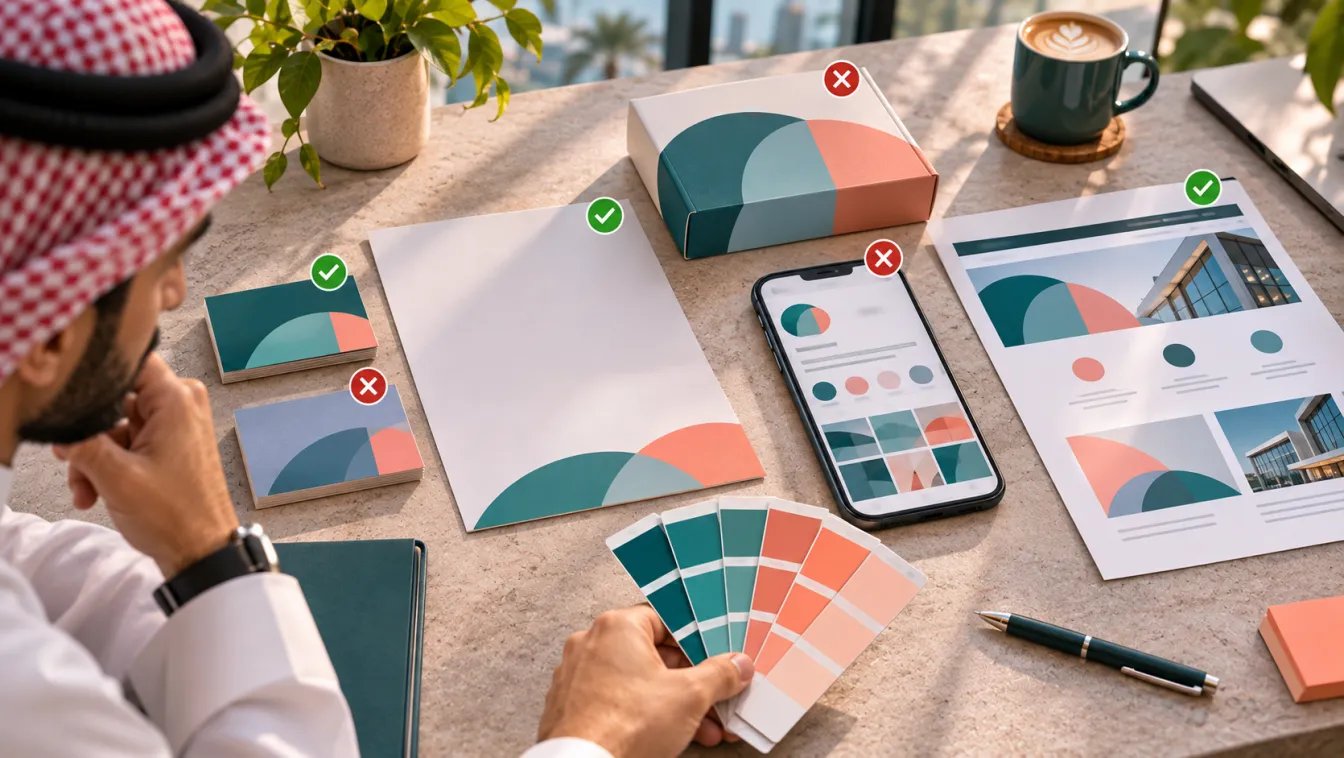
Your brand is not experienced through your logo alone. Customers encounter it through your website, social media, advertisements, emails, proposals, packaging, store environment and conversations with your team. A brand touchpoint audit helps you examine these interactions, identify inconsistencies and understand whether every experience communicates the same identity.
For businesses in Saudi Arabia, this review is particularly useful when marketing activities, branches and digital channels are managed by different teams or suppliers. A structured brand identity system gives those touchpoints a shared foundation, while an audit reveals where the system is working and where it needs attention.
What is a brand touchpoint audit?
A brand touchpoint audit is a structured review of the places and moments where people interact with your business. It evaluates whether your visual identity, messaging, tone of voice and customer experience are consistent with the brand you intend to present.
A touchpoint can be any interaction that shapes someone's impression of your business. It may be a first visit to your website, a reply to a WhatsApp enquiry, a product label, a quotation, a reception sign or a follow-up email after a purchase.
The purpose is not to make every communication look identical. Different channels have different jobs. A social media post should not look like a legal document, and a sales proposal should not read like an advertisement. The goal is to make each interaction feel like it comes from the same organisation, with a recognisable identity and a consistent standard of communication.
A useful audit should answer three questions:
- Are we recognisable? Do customers encounter a consistent visual and verbal identity?
- Are we clear? Do our materials explain what we offer, who we serve and what customers should do next?
- Are we credible? Does the experience we deliver match the expectations created by our marketing?
When should you conduct a brand touchpoint audit?
A review can be useful at several stages of business development. You do not need to wait until the brand looks obviously outdated or customers start complaining.
Consider conducting an audit when:
- Your business has recently changed its positioning, logo or visual identity.
- You have opened new branches or expanded into additional markets.
- Different departments or external suppliers create marketing materials independently.
- Your website, social media and sales documents appear to represent different businesses.
- You are preparing for a campaign, product launch or major business expansion.
- Customers regularly misunderstand your services, products or processes.
- You have merged business units or introduced new product and service lines.
A review is also useful before commissioning a complete rebrand. It helps separate problems that require strategic or visual changes from issues that can be solved through better templates, clearer messaging or improved operational processes.
Step 1: Map every important brand touchpoint
Start by creating an inventory of the places where customers, prospects, employees and business partners encounter your brand. Include both digital and physical interactions, from the first discovery stage to after-sales communication.
Organise the inventory around the customer journey.
Discovery and first impression
These are the places where people first learn about your business:
- Search engine results and business listings.
- Website homepage and landing pages.
- Social media profiles and introductory posts.
- Digital advertisements and campaign visuals.
- Outdoor advertising, storefronts and exhibition stands.
- Recommendations, partner introductions and printed brochures.
Evaluation and decision-making
At this stage, potential customers look for evidence and information that helps them decide:
- Service and product pages.
- Company profiles and capability presentations.
- Product catalogues and brochures.
- Quotations, proposals and tender documents.
- Customer reviews and approved testimonials.
- Sales emails, calls and meeting presentations.
Purchase and service delivery
The experience continues after a customer decides to buy:
- Booking, ordering and payment interfaces.
- Contracts, invoices and confirmation messages.
- Packaging, labels and delivery materials.
- Store or office signage and reception areas.
- Employee uniforms and customer-facing documents.
- Onboarding, support and service communications.
Retention and follow-up
Review how your business maintains the relationship:
- Thank-you and follow-up messages.
- Renewal and reminder communications.
- Customer support responses.
- Feedback requests and complaint handling.
- Loyalty programmes and ongoing customer updates.
Not every touchpoint deserves equal attention. Prioritise interactions that are frequent, commercially important or influential in customer decisions.
Step 2: Review visual consistency
Once you have mapped the touchpoints, compare their visual presentation with the approved brand identity. The purpose is to identify where the brand has drifted, not to criticise every design variation.
Check the following elements:
- Logo: Are approved versions being used? Are proportions, spacing and backgrounds correct?
- Colours: Do teams use the approved primary and secondary colours consistently?
- Typography: Are the correct Arabic and English fonts used with a clear hierarchy?
- Photography: Do images follow a recognisable style and represent the business accurately?
- Graphic elements: Are icons, illustrations, patterns and layouts part of the same visual system?
- Templates: Do recurring materials use approved layouts rather than unrelated designs?
Look at materials side by side. A website may use one colour palette, while a presentation uses another and social media follows a third. Each item may look acceptable in isolation, but together they can weaken recognition.
Also test the identity in real applications. A logo that looks good on a desktop presentation may be difficult to read on a mobile screen, a small product label or a building sign. A visual system should be flexible without losing its defining characteristics.
Step 3: Check messaging and tone of voice
Visual consistency is only one part of the review. Your business should also communicate a clear and recognisable message across channels.
Start with your core positioning. Can a customer understand what you offer, who you serve and why your business is relevant? Then compare how that message appears in your homepage, service pages, sales presentations, advertisements and customer conversations.
Review these areas:
- Brand promise: Do your materials communicate the same central value?
- Terminology: Are products, services and departments described consistently?
- Tone: Does the language reflect the intended personality of the brand?
- Clarity: Are messages direct, specific and understandable to the intended audience?
- Claims: Are statements about quality, experience, results or capabilities accurate and supportable?
- Calls to action: Do customers know what action to take after reading or viewing the material?
For example, a business may describe itself as a specialist provider on its website but use vague, generic language in its proposals. Another may promise a personal service in advertisements while sending automated messages that feel impersonal. These differences create expectations that the customer experience may not fulfil.
Do not force every channel to use the same wording. Instead, establish message principles and approved terminology that teams can adapt to each situation.
Step 4: Evaluate the customer experience
A consistent brand is not only what customers see. It is also what they experience when they interact with your organisation.
Review important moments from the customer's perspective. Can someone find the information they need? Does the sales team respond in a way that reflects the brand's stated values? Are instructions clear after an order or appointment? Does the physical environment match the impression created online?
Consider the following questions:
- Is it easy to understand the next step on the website or enquiry form?
- Do employees explain services and policies consistently?
- Are response times and follow-up expectations communicated clearly?
- Do branches provide a recognisably similar standard of service?
- Are complaints handled respectfully and in line with the brand's service principles?
- Do delivery, onboarding and after-sales communications match the original promise?
This part of the review often requires input from teams beyond marketing. Sales, reception, operations, customer support and branch managers may all see problems that are not visible in campaign materials.
Step 5: Assess your digital and physical channels together
Customers rarely think in terms of internal departments or channel ownership. They experience one business, even when different teams manage its website, social accounts, branches and sales materials.
Review the complete journey rather than treating every channel as a separate project.
For digital channels, check your website, mobile experience, search listings, email templates, social profiles and online advertising. Make sure contact details, service descriptions, visual identity and calls to action are accurate and consistent.
For physical channels, inspect storefronts, reception areas, office signage, packaging, uniforms, printed materials and exhibition spaces. Check whether the brand is visible, readable and appropriate to the environment.
If your business has multiple branches, compare locations. Look for differences in signage, promotional displays, staff materials and customer communication. Some local variation may be necessary, but the core identity and service standards should remain recognisable.
Step 6: Score findings and prioritise improvements
An audit becomes useful when observations turn into decisions. Avoid creating a long list of minor design preferences without identifying which issues matter most.
A simple rating system can help. Score each touchpoint against four criteria:
- Visual consistency: Does it follow the approved identity?
- Message consistency: Does it communicate the right positioning and terminology?
- Experience consistency: Does the interaction match the brand promise?
- Practical quality: Is it clear, usable, accurate and accessible?
You can use a simple scale such as strong, needs improvement and urgent attention. The purpose is to create a shared view of the current situation, not to produce a scientific measurement.
Then classify each finding:
- Critical: A problem that misleads customers, creates significant confusion or involves inaccurate information.
- High priority: A visible inconsistency on an important customer journey or frequently used material.
- Medium priority: A problem that weakens recognition but does not prevent customers from completing an action.
- Low priority: A minor refinement that can wait until higher-impact issues are resolved.
Assign an owner and a practical next step to each priority. Some findings may require a design update, while others need revised copy, staff guidance, better templates or an operational change.
Brand touchpoint audit in the Saudi market
Businesses in Saudi Arabia should include language, location and local customer expectations in their review. Arabic and English applications need to be checked in real contexts, not just approved as separate design files.
Review Arabic right-to-left layouts, headings, forms, navigation, product information and customer messages. Check that English and Arabic communicate the same meaning, especially in service descriptions, policies and important instructions. A literal translation can sometimes sound unnatural or create confusion.
Location information should also be accurate across websites, maps, business listings, advertisements and branch materials. A branding agency in Riyadh may review how a business presents its identity across different customer channels, while a branding agency in Jeddah may consider the same consistency questions for the locations and audiences it serves. The important point is to make sure published branch details, service coverage and contact information reflect the actual operation.
Where communications involve regulated products, professional services, pricing or consumer information, verify relevant requirements with the appropriate Saudi authorities and qualified legal or compliance advisers. An audit should identify content that needs verification; it should not replace specialist regulatory review.
What should your audit report include?
A useful report should help decision-makers understand what is working, what is inconsistent and what should happen next. It does not need to be a lengthy design presentation.
Include:
- Scope: The channels, branches, materials and customer journeys reviewed.
- Current-state summary: A concise overview of the brand's consistency and major observations.
- Evidence: Screenshots, photographs or examples showing each issue.
- Impact: An explanation of how the issue affects recognition, clarity, trust or usability.
- Priority: A rating that helps teams decide what needs attention first.
- Recommended action: A practical correction, such as updating a template, rewriting a message or improving a customer process.
- Ownership: The team or person responsible for implementing the change.
- Review plan: A way to check whether the correction has been applied consistently.
Separate essential corrections from optional design improvements. This makes it easier to agree on the work and avoid turning a focused audit into an unnecessary full rebrand.
Common audit mistakes to avoid
A review can become ineffective when it focuses on appearance without understanding how the business works. Avoid these common mistakes:
- Reviewing only the logo: Brand consistency covers messages, behaviour and customer experience as well as visual design.
- Ignoring internal materials: Quotations, email signatures and service documents may be seen by customers more often than campaign graphics.
- Treating every difference as a problem: Different channels need different formats; consistency does not mean identical layouts.
- Failing to involve operations: Marketing teams cannot assess every service interaction on their own.
- Prioritising personal taste: Recommendations should be linked to brand objectives and customer needs.
- Creating a report without ownership: Findings need named responsibilities and realistic next steps.
- Rebranding before diagnosing: A new identity may not solve problems caused by unclear messaging or inconsistent processes.
How often should you review brand touchpoints?
There is no single schedule that suits every business. A growing company with several branches and active campaigns may need more frequent reviews than a small business with a limited number of customer interactions.
A practical approach is to review the most important touchpoints after a major identity change, new branch opening, website launch, campaign rollout or significant change in services. You can also include a lighter review in your regular marketing and operational planning.
The goal is to make consistency part of how the business operates rather than treating it as a one-time clean-up. Keep the brand guidelines accessible, assign ownership for key materials and review new templates before they are distributed widely.
Work with us: If your business needs a clearer identity system or a structured review of how its brand appears across customer touchpoints, explore our brand identity services. LtsThink can help you identify inconsistencies, refine the visual system and create practical guidelines for your teams and suppliers. You can also read our guide to brand guidelines manuals to understand how to document and maintain consistent brand use.
FAQ
What is a brand touchpoint audit? A brand touchpoint audit is a structured review of the interactions people have with a business. It checks visual identity, messaging, tone and customer experience across digital, physical and interpersonal channels.
What should be included in a brand touchpoint audit? Review your website, social media, advertisements, sales documents, email communication, packaging, signage, customer service and other important interactions. Prioritise the touchpoints that influence customer decisions and experience.
How do you measure brand consistency? Compare each touchpoint against the approved identity, messaging principles and service expectations. Use clear criteria such as visual consistency, message clarity, experience quality and practical usability, then prioritise the issues that matter most.
Does a brand touchpoint audit mean the business needs a rebrand? No. An audit may reveal that the existing identity is appropriate but applied inconsistently. Better templates, clearer messaging, updated guidelines or operational improvements may be enough.
Who should conduct a brand touchpoint audit? The review can involve internal marketing, sales, operations and customer service teams, supported by an experienced brand strategist or agency when an independent assessment is useful.