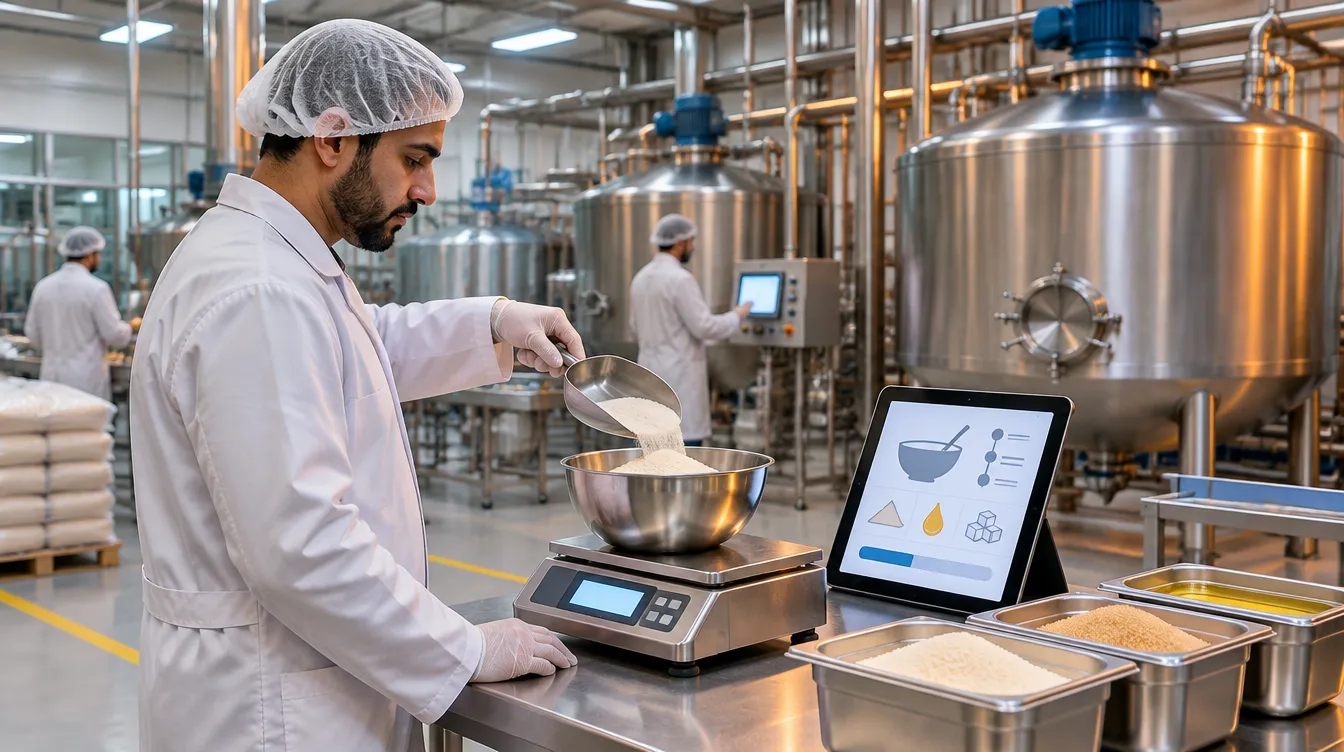
Batch production planning helps food and process manufacturers decide what to produce, in which quantities, when to run each batch and whether the required ingredients, materials, equipment and capacity are available. Unlike a simple production schedule, batch production planning must account for recipes, batch sizes, processing stages, changeovers, quality checks and the relationship between input lots and finished products.
For Saudi factories producing food, beverages, chemicals, cosmetics, plastics or other process-based products, the plan must connect commercial demand with the realities of the production floor. A well-designed manufacturing ERP system can coordinate recipes, inventory, production orders, quality records and costing while giving planners a clearer view of constraints before a batch is released.
What is batch production planning?
Batch production is a manufacturing method in which a defined quantity of a product is made during a production run. The batch follows a specified recipe or bill of materials and a sequence of processing steps. Once the run is completed, the equipment may be cleaned, prepared or adjusted before another product or batch begins.
Batch production planning is the process of organising these runs so that demand, material availability, equipment capacity, labour and production priorities are aligned. It involves more than deciding how many units to make. Planners need to know whether ingredients are available in the correct quantities, whether the required equipment is ready, whether the batch size fits the process and whether the resulting output can be stored or dispatched appropriately.
A batch may be defined by weight, volume, units, a vessel capacity or another production-specific measure. The right definition depends on the factory's process. A beverage plant may plan a mixing tank by volume, while a bakery may schedule dough batches by weight and oven capacity. A chemical manufacturer may need to consider reactor capacity, processing time and controlled operating conditions.
The objective is not to fill every available machine at all times. It is to create a feasible sequence of production runs that meets demand while respecting material, equipment, quality and operational constraints.
How batch production planning works
A practical planning process starts with demand and translates it into production requirements. The planner reviews customer orders, forecasts, replenishment needs and available finished-goods stock. The required quantity is then compared with the production method, standard batch size, available capacity and expected material consumption.
A typical workflow includes:
- Review demand: Consolidate customer orders, forecasts, minimum stock requirements and delivery priorities.
- Check finished-goods inventory: Identify what is already available, what is reserved and what must be produced.
- Calculate batch requirements: Determine the number and size of batches needed to cover the net requirement.
- Verify material availability: Check ingredients, packaging, additives and other required inputs, including their lot status and expiry information where applicable.
- Check equipment and capacity: Confirm vessel, mixer, line, oven or other equipment availability, along with processing and cleaning time.
- Sequence production runs: Arrange batches according to due dates, product compatibility, changeover requirements and operational priorities.
- Release and monitor production: Issue production orders, record actual consumption and output, and update the plan when conditions change.
A planning system should make the assumptions behind the schedule visible. If a batch is delayed because an ingredient is awaiting inspection, the planner needs to understand the effect on dependent orders. If a vessel is unavailable, the system should help identify which alternative sequence is feasible rather than simply showing a missed date.
Recipes, bills of materials and batch sizes
Recipes and bills of materials are central to process manufacturing. They define the expected inputs required to make a product, but they must be structured carefully to support planning and execution.
A recipe may specify ingredients, proportions, processing instructions, expected yield, acceptable substitutions and relevant production parameters. A packaging bill of materials may define bottles, caps, labels, cartons and other components required after the main product has been processed.
The planning system needs to calculate material requirements for the intended batch size. For example, if a recipe is defined for a standard quantity, the system should calculate the expected ingredient quantities for a larger or smaller approved batch. It should also account for units of measure, conversion rules, rounding, minimum issue quantities and any approved process allowances.
However, scaling a recipe is not always a simple mathematical exercise. Some processes have minimum or maximum operating quantities, equipment limitations or parameters that change with batch size. The factory's production and quality teams should define which recipe adjustments are allowed and which require review or approval.
It is also important to distinguish between planned quantities and actual consumption. Operators may record a measured quantity that differs from the recipe expectation, return unused material or report process loss. The system should preserve the planned recipe while recording actual usage against the production batch.
Material planning and inventory readiness
A production schedule is only feasible when the required materials can be issued at the right time. Batch planning therefore depends on accurate inventory records and a clear view of material status.
For food and process manufacturers, availability is not simply a question of whether an item appears in stock. The planner may need to consider:
- Quantity available after existing reservations and allocations.
- Supplier and internal lot identification.
- Quality inspection and release status.
- Expiry dates or remaining shelf life where relevant.
- Storage conditions and location restrictions.
- Approved substitutes and recipe constraints.
- Packaging materials needed to complete the finished product.
A system should distinguish between physical stock, usable stock, quarantined stock and quantities already committed to other orders. This prevents a schedule from relying on material that cannot actually be consumed.
The relationship between planning and inventory is explored further in our guide to manufacturing inventory management. For batch operations, this connection is particularly important because an unavailable ingredient or packaging component can delay an entire production run, even when most other materials are ready.
Capacity planning, equipment and production sequence
Batch manufacturers often share equipment across several products. A mixing vessel, reactor, filling line, oven or packaging machine may be required by multiple production orders. A schedule that ignores these shared resources can create conflicts even when all materials are available.
Capacity planning should consider more than nominal machine capacity. Relevant factors may include:
- Available operating hours and planned shifts.
- Batch size limits and equipment compatibility.
- Processing, heating, cooling or settling time.
- Cleaning, sanitation and changeover requirements.
- Planned maintenance and equipment availability.
- Labour skills and operator availability.
- Downstream capacity, such as filling, packing or storage.
Production sequence also matters. Running compatible products together may reduce cleaning or setup work, while changing between certain products may require additional preparation. In food manufacturing, allergen controls or cleaning validation requirements may influence the order of production. In chemical or other process environments, product compatibility and approved operating procedures may determine which runs can follow one another.
A useful schedule makes these constraints explicit. It should not assume that a machine becomes available immediately when a batch reaches its planned completion time. Processing, unloading, cleaning, inspection and setup may all need to be included before the next batch can begin.
Batch production planning for different industries
The planning model should reflect the production method and control requirements of each industry.
Food and beverage: Planners may need to coordinate ingredients, recipes, mixing, cooking, cooling, filling, packaging and finished-goods release. Ingredient lots, expiry information, allergen controls and cleaning requirements can affect the sequence. The plan should also connect the production batch to the packaging materials and finished-product identity.
Dairy and bakery: Shelf life, production windows, temperature-sensitive stages and equipment capacity may influence scheduling. A bakery may need to coordinate dough preparation, proofing and oven availability, while a dairy operation may plan processing and filling around product and equipment requirements.
Chemicals and process manufacturing: Batch size, reactor or vessel capacity, processing time, operating parameters and material compatibility can be central planning constraints. The production record may need to connect ingredient lots, process stages, operator confirmations and quality results.
Cosmetics and personal care: Formulation ingredients, mixing stages, filling capacity, packaging components and quality release can all influence the schedule. A finished product may require separate planning for bulk preparation and subsequent filling or packing.
Plastics and packaging: Some factories combine batch-based material preparation with continuous or repetitive downstream production. Resin blends, colour concentrates, additives and machine availability may need to be coordinated across preparation and production stages.
These examples illustrate planning considerations rather than universal regulatory requirements. Each factory should define its own approved recipes, quality controls, product restrictions and recordkeeping rules with the relevant technical and quality teams.
Connecting ERP, MRP and MES to batch planning
Batch planning becomes more useful when it is connected to the systems that manage business demand, materials and actual production execution.
ERP provides the business context: customer orders, forecasts, inventory, purchasing, production orders and financial records. Material Requirements Planning, or MRP, calculates the materials needed based on demand, product structures, stock and supply information. A planning or scheduling layer then considers production capacity, equipment availability, batch sizes and sequencing constraints.
MES supports execution after work is released. It can provide operators with production instructions, capture actual ingredient consumption, record process checks and report completed quantities, losses or deviations. Actual results can then be sent back to ERP to update inventory and production status.
This division of responsibilities matters. A plan may state that a batch requires a particular quantity of an ingredient, but the production record should show what was actually issued and consumed. Similarly, ERP may show a planned completion date, while the execution system records when the batch really started and finished.
Factories considering the boundary between these systems can read our guide to ERP vs MES for manufacturing. The right architecture depends on how much execution detail the factory needs and which capabilities are already available in its current software.
Traceability and quality controls within batch planning
Every production batch should have a clear identity that connects its inputs, process history, inspections and resulting output. This is essential when a factory needs to investigate a quality issue, review a process deviation or respond to a customer query.
The system should record which ingredient and packaging lots were issued to the batch, which production order was used, what process stages were completed and which quality checks were recorded. If the batch is divided into smaller quantities, combined with another approved batch or sent through rework, those relationships should remain visible.
Quality controls should be placed at the appropriate points in the production workflow. Some checks may be required before material issue, others during processing, and others before finished goods are released. A batch should not move to the next controlled stage simply because the schedule says it is ready; required approvals and status changes must be respected.
A connected manufacturing traceability system can preserve the relationship between supplier lots, production batches and finished-product dispatch. Planning, execution, quality and traceability should therefore use consistent batch identifiers rather than separate codes that are difficult to reconcile.
Common batch planning problems and how to address them
One common problem is planning with inaccurate inventory. A spreadsheet may show sufficient stock even though some material is reserved, expired, awaiting inspection or stored in a location that cannot supply the production line. Improve the process by using clear stock statuses, timely transactions and reliable lot records.
Another issue is treating every batch as if it has the same size and processing time. Actual constraints may vary by product, equipment, recipe and packaging format. Maintain approved production parameters and review them when processes or equipment change.
Frequent schedule changes can also create confusion. A new urgent order, delayed supplier delivery or equipment issue may require resequencing. The planner needs visibility into the affected batches, material commitments and downstream delivery dates. Changes should be communicated to the relevant teams and recorded with a clear reason.
A further challenge is failing to record actual consumption and output. If production reports only the planned quantity, managers cannot reliably understand yield differences, waste, rework or the materials remaining after the run. Make actual reporting part of the production workflow, with clear responsibility for recording and reviewing exceptions.
Finally, avoid overcomplicating the first implementation. A factory with inconsistent item codes, incomplete recipes or unreliable stock transactions should correct these foundations before introducing advanced scheduling rules. Better planning depends on dependable data and disciplined operating processes.
How to implement batch production planning software
Start by documenting how products are formulated, scheduled, processed, inspected, packed and released. Include the people who understand production constraints, not only the software or IT team.
A practical implementation can follow these steps:
- Map products and recipes: Review product structures, units of measure, batch sizes, approved alternatives and process stages.
- Document resources: List equipment, capacities, operating calendars, shifts, cleaning requirements and maintenance constraints.
- Review inventory data: Validate item codes, supplier records, lot information, stock statuses and warehouse locations.
- Define planning rules: Agree how demand is translated into batches, how priorities are set and how the schedule responds to shortages or delays.
- Configure a representative product family: Test a realistic end-to-end workflow, including material checks, production execution, quality approval and finished-goods receipt.
- Pilot and refine: Compare planned and actual results, identify data or process gaps, and adjust the planning rules before expanding.
Choose a system based on the factory's real planning requirements. Check whether it supports the required recipe structure, batch scaling, material reservations, equipment constraints, production reporting, traceability and integration with existing systems. Evaluate the planner's interface as well as the operator's experience on the shop floor.
For manufacturers reviewing manufacturing ERP in Riyadh or other Saudi industrial locations, the system should also fit the company's Arabic and English working environment, local business processes and support arrangements. A demonstration should use the factory's own products and constraints rather than generic sample data.
When is a factory ready for advanced batch planning?
A factory may be ready when production schedules frequently conflict with material availability, equipment is shared across products, planners struggle to coordinate changeovers, or actual batch performance is difficult to compare with the original plan.
However, advanced planning software is not always the first priority. If recipes are not controlled, inventory transactions are unreliable or production teams do not record actual consumption, those issues should be addressed before automating complex schedules. A simple, disciplined planning process can be more useful than sophisticated software built on inconsistent data.
The best starting point is a defined product family and a real production scenario. Follow the process from demand through material checks, batch scheduling, execution, quality approval and finished-goods receipt. Identify which decisions need automation, which require planner judgement and which must remain subject to technical or quality approval.
LtsThink designs manufacturing ERP and MES solutions around the operating model of each factory. The goal is to connect planning with inventory, production execution, quality and costing in a way that supports the actual process rather than forcing the factory into an unsuitable template.
Work with us: LtsThink helps Saudi manufacturers connect batch planning, material management and shop-floor execution through a manufacturing ERP and MES solution. If your team is reviewing how production orders and schedules should work, explore our guide to production planning software or contact our team to discuss your factory's requirements.
FAQ
What is batch production planning?
Batch production planning organises production runs by deciding which products to make, how many batches are required, when each batch should run and whether materials, equipment and capacity are available. It also considers recipes, processing stages, changeovers and quality requirements.
How is batch planning different from general production planning?
General production planning can cover different manufacturing models, including continuous, repetitive and discrete production. Batch planning focuses on defined production quantities or runs and must account for batch sizes, recipes, processing sequences, cleaning and the relationship between input lots and finished output.
Can ERP software manage batch production planning?
Yes, depending on the ERP's manufacturing and planning capabilities. Some systems support recipes, batch orders, material requirements, inventory and production scheduling. More complex operations may need additional scheduling tools or MES integration for detailed shop-floor execution.
What information is needed to plan a production batch?
Typical inputs include demand, finished-goods stock, recipe or bill of materials, batch size, material availability, lot and quality status, equipment capacity, processing time, cleaning requirements and delivery priorities. Actual production results should also be recorded to improve future planning.