

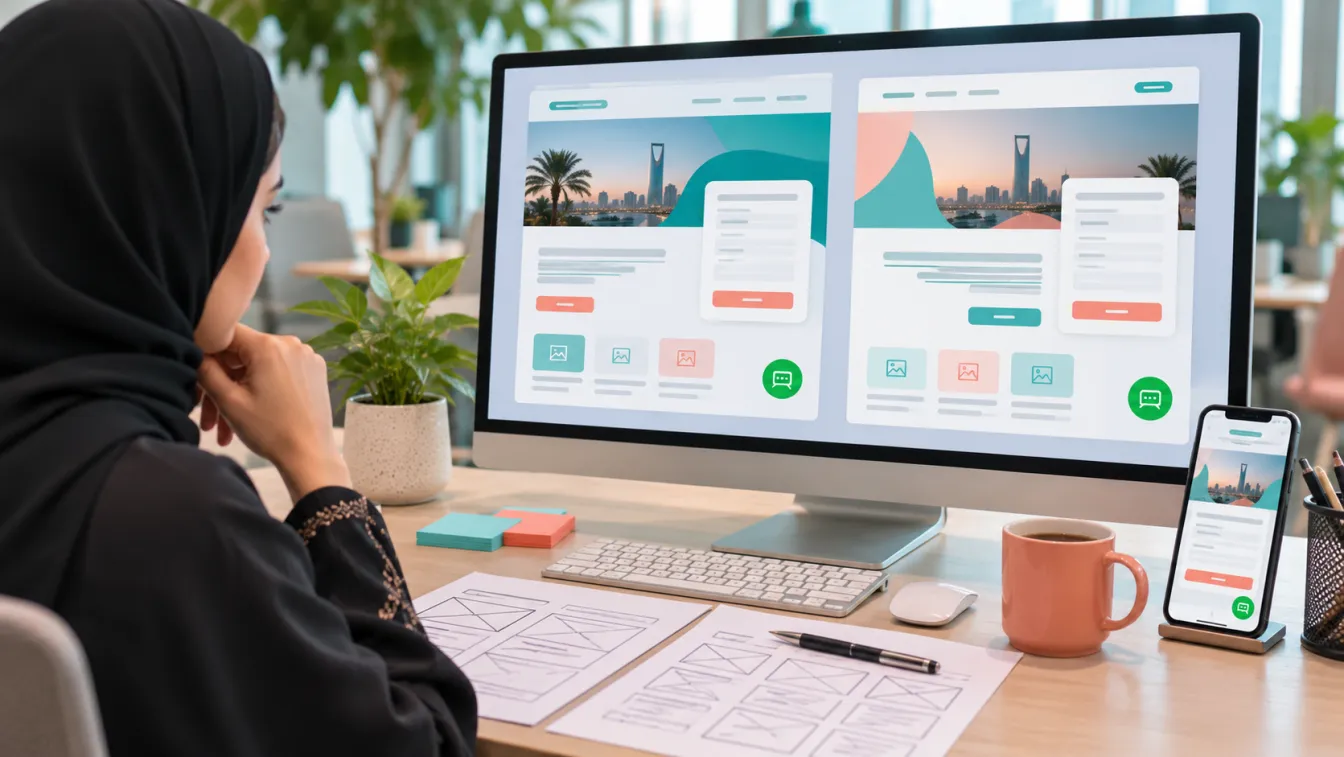
Landing page optimization is the process of improving a specific website page so visitors can understand an offer and take the intended action. For Saudi businesses, this means creating focused pages that connect advertising messages, Arabic and English content, mobile experiences and clear enquiry options to generate meaningful business leads.
Sending visitors to a website is only part of the marketing process. If the page does not explain the offer, answer customer questions or make contacting the business easy, advertising traffic may not produce useful enquiries. A well-planned website development service should therefore consider the customer journey and the purpose of every landing page before focusing on its visual appearance.
What Is Landing Page Optimization?
A landing page is a specific website page designed around a particular campaign, audience, service or business objective. Unlike a general homepage, it focuses on one primary offer and guides visitors towards a relevant next step.
That action could be requesting a quotation, booking an appointment, asking about a property, registering for a course, contacting a service provider or purchasing a product.
Landing page optimization focuses on improving the page itself. It examines the structure, message, content, form, loading experience and language presentation to make the intended action easier to understand and complete.
Consider a hypothetical Saudi company offering accounting software. It launches a Google Ads campaign targeting businesses looking for accounting solutions. Instead of sending every visitor to its general homepage, the company creates a dedicated page explaining the accounting product, its intended users, important capabilities and consultation process.
The page gives visitors a direct path from their original search to the information they need. This is the central purpose of landing page optimization: reducing the distance between a visitor's intention and the action the business wants them to take.
Why Landing Pages Matter for Saudi Businesses
Saudi customers use different channels and languages when researching products and services. A visitor may discover a business through Google Search, see a paid social advertisement, visit a website in Arabic or English and then contact the company through WhatsApp.
The landing page connects these interactions with the business offer.
A properly planned page can help businesses:
- Explain a specific service without distracting visitors with unrelated information.
- Match the promise made in a Google or social media advertisement.
- Present Arabic and English information naturally.
- Answer important customer questions before an enquiry.
- Make forms and WhatsApp contact options easy to find.
- Build confidence through relevant business information.
- Provide a consistent experience across mobile and desktop devices.
- Support more meaningful enquiries for the sales team.
For example, a hypothetical real estate developer promoting a residential project needs a page that explains the property's location, available unit types, features and enquiry process. Sending visitors to a general corporate homepage may force them to search through several sections before finding the relevant project information.
A focused page makes the next step clearer and gives the marketing team a more useful destination for campaign traffic.
How to Structure a Landing Page That Generates Enquiries
The structure should follow the questions a potential customer needs answered before taking action. Every section should contribute to understanding the offer or building confidence.
1. Start With a Clear Headline
The headline is one of the first things visitors notice. It should explain what the business offers and why the page is relevant to the visitor.
Avoid vague statements that could describe almost any company. Instead, communicate the actual service, product or customer problem being addressed.
For example, a hypothetical professional training provider could use a headline explaining its corporate training programmes for Saudi businesses rather than a generic statement about developing potential.
A useful headline should:
- Describe the offer clearly.
- Reflect the visitor's likely search or advertisement.
- Use familiar language for the intended audience.
- Avoid unsupported promises or exaggerated claims.
2. Explain the Offer Immediately
The introductory section should answer three practical questions:
- What is being offered?
- Who is it intended for?
- What should the visitor do next?
A short supporting paragraph can explain the main benefit and clarify the service scope. Visitors should not need to scroll through a long introduction to understand why they arrived on the page.
Use concise language, meaningful headings and clear calls to action. If the service involves a consultation, explain what the consultation is intended to help the customer understand.
3. Show Relevant Benefits and Features
People evaluating a product or service need to understand what they will receive.
Organise the information around customer needs rather than listing internal company capabilities without context.
Useful content may include:
- What the service includes.
- Problems the offer is designed to address.
- Important product or service features.
- Who is likely to benefit.
- How the process works.
- What happens after submitting an enquiry.
For a hypothetical B2B software provider, this might include explaining procurement workflows, inventory visibility, reporting capabilities and implementation stages. The visitor receives useful information without having to request a sales presentation just to understand the basic offer.
4. Add Trust-Building Information
Visitors may hesitate because they do not know the business or understand how the service will be delivered.
Address those concerns with relevant information such as:
- A clear explanation of the business.
- Service scope and responsibilities.
- Contact information.
- Implementation or delivery process.
- Frequently asked questions.
- Relevant professional credentials where genuinely applicable.
- Transparent terms and conditions where necessary.
Do not invent customer testimonials, results, awards or credentials. If a business cannot publish genuine evidence, it can still build confidence through clear explanations, accessible contact information and a transparent working process.
5. Make the Call to Action Visible
A call to action tells visitors what to do next. Examples include requesting a consultation, asking for a quotation, booking an appointment or contacting the business.
The wording should match the commitment being requested. A visitor who is still evaluating a complex service may prefer to request information rather than immediately commit to a purchase.
Use consistent wording throughout the page and make sure the destination works correctly. Avoid placing several competing primary actions next to each other without explaining their differences.
Message Match: Connect the Advertisement to the Landing Page
Message match means maintaining consistency between the advertisement, search query and destination page.
When a visitor clicks an advertisement, they have an expectation about what they will find. If the landing page presents an unrelated message, the experience becomes confusing.
A practical message-matching process includes:
- Reviewing the keywords and search intent behind the campaign.
- Identifying the promise or offer presented in the advertisement.
- Using a relevant headline on the destination page.
- Explaining the same service or product in the page content.
- Keeping the call to action consistent with the campaign objective.
- Checking that the page works for the audience and language being targeted.
Imagine a hypothetical clinic advertising a particular consultation service. If the advertisement refers to that consultation but the destination page only displays a general list of medical departments, visitors may struggle to find the information they expected.
A dedicated page should explain the advertised service, provide appropriate information and make the booking or enquiry process clear.
This principle applies to organic search as well. A visitor searching for a specific service should arrive at a page that answers that particular need rather than being forced to navigate through unrelated content.
Forms and WhatsApp: Make Enquiries Easy
The enquiry process can become an obstacle even when the rest of the page is well designed.
A form that requests too much information, contains unclear fields or does not work properly on mobile devices can discourage visitors from completing it.
Build Forms Around Necessary Information
Start by identifying what the business genuinely needs to respond to an enquiry.
A basic service enquiry form might request:
- Name.
- Business email or preferred contact information.
- Telephone number where necessary.
- Service of interest.
- A short description of the requirement.
The appropriate fields depend on the business. A property enquiry may need the visitor's preferred property type, while a B2B service request may require information about the organisation and its needs.
Avoid collecting information simply because it might be useful later. Request only what is reasonably necessary for the stated purpose and explain how the information will be handled.
Use WhatsApp as a Practical Contact Option
WhatsApp is a familiar communication channel for many Saudi customers. Including a WhatsApp contact option can make it easier for visitors to ask a question without completing a longer form.
However, the implementation should be considered carefully:
- Use a working business contact number.
- Make the WhatsApp button easy to identify.
- Use a relevant pre-filled message where appropriate.
- Ensure the message reflects the page or service being promoted.
- Make sure the business has a process for responding to enquiries.
- Record relevant interactions where the measurement setup supports them.
A WhatsApp button click does not necessarily mean a conversation has started or a qualified lead has been received. The business should distinguish between opening a conversation and receiving a genuine enquiry.
For businesses using both forms and WhatsApp, the page should make the available options clear without overwhelming visitors with unnecessary choices.
Page Speed and Mobile Experience
A landing page must work properly on the devices customers actually use. A visually attractive desktop page can still create problems if its mobile version is difficult to navigate or slow to load.
Review these technical and usability areas:
- Compress images and use suitable modern image formats.
- Avoid unnecessary scripts and third-party integrations.
- Reduce render-blocking resources where possible.
- Use appropriate caching and hosting configurations.
- Check mobile layout and text readability.
- Make buttons large enough to interact with comfortably.
- Ensure forms are easy to complete on smaller screens.
- Test telephone and WhatsApp links.
- Check that important information is visible without excessive scrolling.
Performance improvements should be based on actual testing rather than assumptions. Use suitable website performance tools and test representative mobile devices and network conditions.
Also review the technical quality of the page after adding advertising pixels, analytics scripts, chat tools or other integrations. These additions may affect loading behaviour if they are not implemented carefully.
Arabic and English Landing Page Design
A bilingual Saudi website needs more than translating the same page and changing its direction. Each language version should feel natural and usable for its intended audience.
For Arabic pages, pay attention to:
- Correct right-to-left layout throughout the page.
- Natural Saudi business terminology where appropriate.
- Proper alignment of headings, forms and navigation.
- Arabic calls to action that communicate the intended action clearly.
- Correct display of telephone numbers, email addresses and mixed-language technical terms.
- Readable Arabic fonts and appropriate line spacing.
For English pages, maintain consistent terminology and ensure that the content addresses the needs of English-speaking customers.
Both versions should preserve the same business objective, but the wording and presentation do not have to be literal translations. Arabic-first content should reflect how Saudi customers actually search and communicate.
For example, a hypothetical company offering digital accounting services may need different introductory wording in Arabic and English while presenting the same service scope and enquiry options.
Check that language-switching links lead to the equivalent page wherever one exists. Do not automatically send visitors to the homepage when a corresponding service page is available.
How to Measure Landing Page Performance
Measurement helps identify whether the page is attracting relevant visitors and supporting the intended action.
Useful indicators include:
- Landing-page visits by acquisition source.
- Engagement with the page content.
- Successful form submissions.
- WhatsApp and telephone link interactions.
- Appointment or quotation requests.
- Completed purchases where applicable.
- Quality of enquiries recorded by the sales team.
Use Google Analytics 4 and Google Tag Manager to configure the relevant events. Make sure successful form submissions are distinguished from button clicks and failed submissions.
If the page supports an advertising campaign, review the campaign message, audience and destination together. A low number of enquiries does not automatically mean the page design is the only problem. The audience, offer, advertising intent, sales response and measurement setup may also need investigation.
It is equally important to distinguish individual page improvements from a broader website experimentation programme. Landing page optimization focuses on improving the specific destination page and its ability to communicate an offer and collect enquiries. A site-wide conversion optimisation process involves broader research, hypotheses, controlled A/B tests and prioritisation across multiple pages and user journeys.
Common Landing Page Mistakes to Avoid
Even well-designed pages can fail to support the intended business action. Watch for these problems:
- Generic headlines: Visitors cannot immediately understand what the business offers.
- Advertisement mismatch: The page does not deliver the information promised in the advertisement.
- Too much information: Long, unfocused sections hide the important message and next step.
- Too many calls to action: Competing options make the visitor uncertain about what to do.
- Complicated forms: Unnecessary fields increase the effort required to enquire.
- Poor mobile layout: Text, buttons and forms become difficult to use on smaller screens.
- Slow page loading: Heavy images and unnecessary scripts affect the experience.
- Weak Arabic localisation: Literal translations and incorrect RTL layouts make the page feel unnatural.
- Missing follow-up: Enquiries are submitted but nobody takes responsibility for responding.
- Incorrect measurement: Button clicks are reported as successful leads even when no enquiry is received.
The right solution depends on the actual problem. Sometimes the headline needs clarification; in other cases, the form, page speed or campaign destination needs attention.
When Should You Improve a Landing Page Before Spending More on Ads?
Increasing advertising activity is not always the right response to weak campaign results.
Consider improving the landing page first if:
- Visitors arrive but cannot understand the offer.
- The advertisement and page communicate different messages.
- Important service information is missing.
- The enquiry form is difficult to complete.
- WhatsApp or telephone contact options do not work correctly.
- The Arabic or English experience is incomplete.
- Mobile users encounter layout or usability problems.
- The sales team receives enquiries that do not match the advertised service.
There are also situations where a new landing page is premature. If the offer itself is unclear, the business has not identified its intended audience or the sales team cannot respond to enquiries, creating another page will not solve the underlying problem.
Start by clarifying the offer, understanding customer needs and establishing a workable enquiry process. Advertising should support a functioning business journey, not compensate for missing fundamentals.
How LtsThink Builds Landing Pages Around Business Goals
At LtsThink, landing pages are planned as part of the wider marketing and website experience. The objective is to connect the advertising message, customer expectations, page content and enquiry process.
Our approach can include:
- Reviewing the campaign objective and target audience.
- Researching Arabic and English search intent.
- Planning the page structure and content hierarchy.
- Writing clear Arabic-first and English supporting copy.
- Designing responsive layouts for mobile and desktop.
- Developing bilingual pages through our own web team.
- Connecting forms, WhatsApp and other contact options.
- Implementing relevant GA4 and Google Tag Manager events.
- Checking page speed, usability and technical functionality.
- Reviewing the complete journey from advertisement to enquiry.
We also coordinate landing pages with digital marketing services in Saudi Arabia so that advertising, SEO, content and website development support the same business objectives.
Our web development services cover the technical implementation needed to create and maintain business websites and focused landing-page experiences. This allows the marketing and development teams to coordinate content, design, integrations and measurement rather than treating them as disconnected tasks.
The required scope depends on the page complexity, languages, integrations, content requirements and campaign objectives. LtsThink prepares a fixed-price proposal after a short discovery call, based on the actual requirements.
For businesses that need more than a single landing-page improvement, a broader website review may also be appropriate. The first priority should always be identifying the specific obstacle preventing visitors from taking the intended action.
Work with us: Looking for a digital marketing agency in Riyadh or a team that works across the Kingdom? Explore our web development services in Saudi Arabia to create bilingual websites and focused landing pages that support your marketing objectives. You can also read our guide to conversion rate optimization in Saudi Arabia to understand the wider process of researching, testing and improving customer journeys across a website.
FAQ
What is landing page optimization?
It is the process of improving a specific website page so visitors can understand an offer and complete an intended action. It includes page structure, message matching, content, forms, speed, mobile usability and language presentation.
Should I create a separate landing page for every advertising campaign?
Not necessarily. Create separate pages when campaigns target meaningfully different services, audiences or offers. Campaigns with similar objectives may use the same well-structured page, provided the message remains relevant to visitors.
Should my Saudi business have separate Arabic and English landing pages?
If your business serves Arabic-speaking and English-speaking customers, separate language versions can provide a more natural experience. Each page should use appropriate language, layout and calls to action while supporting the same business objective.
Is a WhatsApp button enough to generate leads?
No. A WhatsApp button provides a contact option, but generating useful enquiries also depends on the offer, page message, customer intent and response process. Businesses should distinguish between button clicks and actual conversations or qualified leads.
How is landing page optimization different from conversion rate optimization?
Landing page optimization focuses on improving an individual page, including its structure, message match, form, speed and language experience. Conversion rate optimization is a broader, site-wide process involving research, hypotheses, A/B testing, prioritisation and continuous evaluation across multiple pages and customer journeys.


