

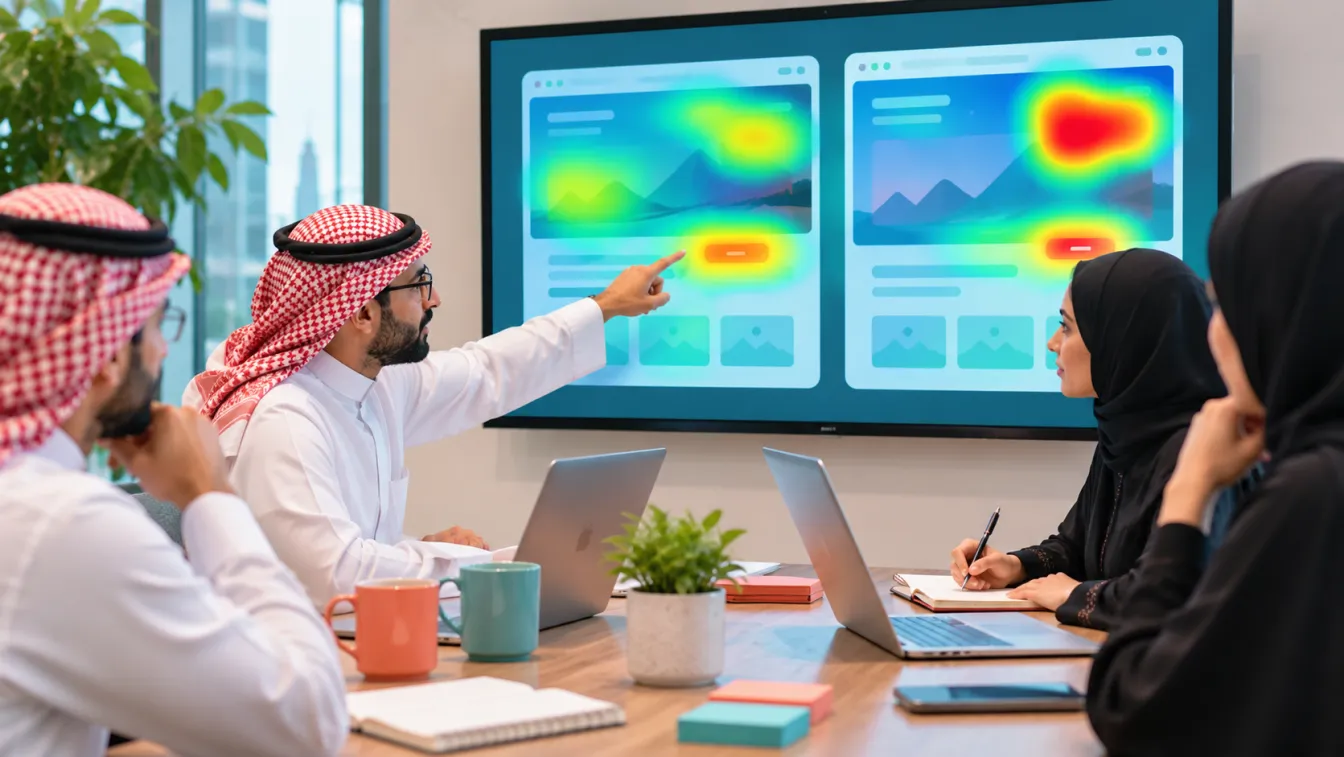
Conversion rate optimization is the ongoing process of understanding why website visitors do not complete important actions and improving the experience that helps them do so. For Saudi businesses, this may mean helping more relevant visitors request a consultation, submit an enquiry, book an appointment or complete an online purchase. The objective is not simply to attract more traffic, but to make the existing customer journey clearer and more effective.
A website can receive visitors from Google, social media, paid advertising and referrals without generating the business results its owner expects. The problem may be unclear messaging, a complicated form, limited trust signals, poor mobile usability or a gap between the advertisement and the page. A wider digital marketing strategy in Saudi Arabia should therefore consider what happens after someone arrives, not just how the visitor gets there.
Why Conversion Rate Optimization Matters for Saudi Businesses
Marketing activity creates opportunities, but the website experience influences whether visitors take the next step. If a business invests in advertising while its website makes it difficult to understand the offer or contact the team, some of that marketing effort is wasted.
Consider a hypothetical Saudi company offering professional services. Its advertising attracts relevant visitors, but the service page describes the company rather than explaining the customer's problem, the process and the next action. Visitors may leave because they cannot quickly determine whether the service is right for them.
Improving the experience can involve:
- Making the main offer easier to understand.
- Matching landing-page content with the visitor's original search or advertisement.
- Improving navigation and page structure.
- Reducing unnecessary form fields.
- Making contact and booking options more visible.
- Providing credible information that addresses customer concerns.
- Improving mobile usability and page performance.
- Testing changes instead of relying entirely on assumptions.
The right improvement depends on the business model and the action that matters. An e-commerce store needs a different journey from a property developer, clinic or B2B consultancy.
Understand What Counts as a Conversion
Before changing a website, define the actions that represent meaningful progress for the business.
A conversion could be:
- A completed purchase.
- A qualified service enquiry.
- A consultation request.
- An appointment booking.
- A quotation request.
- A completed registration.
- A telephone call from a relevant prospect.
- A WhatsApp conversation that develops into a genuine business opportunity.
Not every interaction should be treated as an equivalent result. A visitor opening a contact page is not the same as a qualified enquiry, and a WhatsApp button click does not necessarily mean a message was sent.
For businesses with longer sales cycles, it is useful to distinguish between an initial action and a commercial outcome. A B2B enquiry may require qualification, a meeting, a proposal and a decision before becoming a customer.
This distinction helps teams improve the actions that matter rather than optimising a website around superficial activity.
Common Reasons Website Visitors Don't Convert
Low conversion activity rarely has one universal explanation. The cause may involve the offer, the audience, the page, the technical experience or the sales process that follows an enquiry.
The Offer Is Not Clear
Visitors should be able to understand what the business provides, who it serves and why the offer may be relevant to them.
Generic statements such as “quality solutions” or “professional services” do not explain what a customer will actually receive. Replace vague claims with specific descriptions of services, deliverables, process and intended customer needs.
For example, a hypothetical facilities company could explain the types of properties it serves, the maintenance activities it handles and how a customer can request an assessment.
The Page Does Not Match the Advertisement
A visitor who clicks an advertisement about a specific service expects to find information about that service. Sending that person to a generic homepage creates unnecessary work and can interrupt the decision process.
Keep the message consistent across the advertisement, headline, page content and call to action. If a campaign promotes a particular product or service, the destination should address that exact interest.
The Website Does Not Build Enough Trust
Customers may hesitate when a website does not provide enough information to support a decision.
Useful trust elements can include:
- A clear business identity and contact information.
- Detailed service or product descriptions.
- Transparent process information.
- Relevant credentials or qualifications where accurate.
- Genuine customer feedback where permission has been obtained.
- Clear delivery, booking, payment or service conditions.
- Privacy information and secure website functionality.
Do not add invented testimonials, unsupported claims or misleading trust symbols. Trust comes from accurate and useful information, not decorative badges.
Forms Create Too Much Friction
A form that asks for unnecessary information can discourage visitors from completing it.
Review every field and ask whether the business genuinely needs that information at the first contact stage. A simple consultation request may need only basic contact details and a short description of the requirement. Additional qualification can happen during the follow-up conversation.
Explain what happens after submission. Visitors should know whether they will receive a call, an email or another response.
Mobile Experience Is Difficult
A website may look good on a desktop screen but become frustrating on a phone. Text may be difficult to read, buttons may be too small, forms may be awkward and important information may appear too far down the page.
Test the complete journey on common mobile screen sizes. Check navigation, page loading, input fields, button placement and the process of completing the intended action.
The Sales Follow-Up Is Weak
A website can generate enquiries successfully while the business still struggles to convert them into customers.
Delayed responses, unclear ownership, inconsistent follow-up and irrelevant sales messages can undermine the experience after the form is submitted.
Website improvements should therefore be reviewed alongside the process that handles incoming leads. Marketing, customer service and sales teams need a shared understanding of what happens after a visitor takes action.
How to Build a Conversion Rate Optimization Process
Conversion rate optimization should be a continuous improvement process, not a collection of random design changes. A practical approach begins with evidence, identifies the most important obstacles and evaluates changes carefully.
1. Establish a Baseline
Start by understanding the current customer journey and defining the main conversion events.
Review relevant information such as:
- Website traffic sources.
- Landing pages receiving visits.
- Contact and enquiry form activity.
- Product or service page engagement.
- Mobile and desktop behaviour.
- Checkout or booking completion where relevant.
- Qualified leads and sales outcomes when available.
Use Google Analytics 4, advertising reports, CRM records and website analytics where appropriate. Check that tracking is configured correctly before interpreting the results.
2. Research Visitor Behaviour
Analytics can show where visitors leave, but it may not explain why they leave.
Combine quantitative information with qualitative research. Depending on the website and available tools, this may include:
- Reviewing common customer questions.
- Speaking with sales and support teams.
- Analysing search terms that bring visitors to the page.
- Reviewing form abandonment patterns.
- Collecting voluntary customer feedback.
- Using privacy-conscious session analysis or heatmaps where appropriate.
- Testing the website as a first-time visitor.
For a hypothetical Saudi e-commerce business, customer support may repeatedly receive questions about delivery conditions. That observation could indicate that delivery information should be easier to find before checkout.
3. Identify and Prioritise Problems
Do not attempt to redesign every page at once. Identify the barriers most likely to affect important customer actions.
A useful prioritisation approach considers:
- The importance of the page to the business.
- The number and relevance of visitors using it.
- The seriousness of the observed problem.
- The evidence supporting the proposed change.
- The effort required to implement and evaluate it.
A confusing enquiry form on a key service page may deserve attention before a minor visual adjustment on a low-priority article.
4. Develop a Testable Hypothesis
A hypothesis explains what you intend to change, why you expect it to help and which outcome will indicate whether the change worked.
For example: “If we explain the service process before the contact form, visitors may feel more confident about submitting an enquiry because they will understand what happens next.”
This is more useful than simply deciding that a different button colour should improve results.
5. Test and Evaluate Changes
Where traffic and technical conditions allow, use A/B testing to compare different versions of a page or element. Ensure that the test has a clear objective and that other major changes do not make the results difficult to interpret.
Not every website has enough suitable traffic for a reliable A/B test. In those cases, usability reviews, customer feedback and carefully monitored improvements may be more practical.
Document what was changed, when it was introduced, what was measured and what the team learned. A test that does not produce the expected result can still provide useful information.
Improve the Entire Customer Journey, Not Just One Button
A conversion decision is influenced by several connected experiences. Improving a single button while ignoring the rest of the journey may not solve the real problem.
Review the following areas together:
- Discovery: Does the visitor arrive through a relevant search, advertisement or referral?
- Message: Does the page explain the offer in language the visitor understands?
- Evidence: Does the content answer important questions and build confidence?
- Usability: Can visitors navigate the page and complete the required action easily?
- Contact: Are forms, telephone options and WhatsApp links clear and functional?
- Follow-up: Does the business respond appropriately after an enquiry?
- Measurement: Can the team connect website activity with meaningful outcomes?
For a focused review of an individual campaign page, see our guide to landing page optimization in Saudi Arabia. Landing-page optimization concentrates on improving a particular page's message, structure, content and action. The wider conversion rate optimization process uses research and testing across the customer journey and, where relevant, multiple pages and channels.
Arabic and English Website Experience in Saudi Arabia
A bilingual website needs more than translated text. Arabic and English visitors should both be able to understand the offer and complete the intended action comfortably.
For Arabic pages, review:
- Right-to-left layout and navigation.
- Arabic typography and readability.
- Form labels and validation messages.
- Button alignment and placement.
- Mobile rendering and content spacing.
- Currency, dates and other locally relevant information where applicable.
For both languages, ensure that the service description, terms and calls to action are consistent. Avoid sending visitors to an English page when the advertisement and customer expectation are clearly Arabic, or the reverse.
The right approach is to design each language experience deliberately while keeping the underlying business information accurate and consistent.
Measure Improvements Without Chasing Vanity Metrics
A conversion programme needs measurement that reflects business value.
Useful indicators may include:
- Completed forms and qualified enquiries.
- Purchases and completed bookings.
- Enquiry quality by landing page or acquisition source.
- Progress from initial enquiry to sales opportunity.
- Checkout or booking abandonment patterns.
- Mobile versus desktop completion behaviour.
- Revenue or commercial outcomes where reliable records are available.
Interpret these measurements in context. A page may generate more enquiries but attract people who are not suitable customers. Another page may receive fewer enquiries but produce better-qualified opportunities.
Use conversion tracking to record relevant actions and connect website activity with CRM or sales outcomes where possible. Our performance marketing services can help coordinate campaign measurement with the wider acquisition process. For the technical setup of events and tags, read conversion tracking in Saudi Arabia.
Do not claim that a design change caused an improvement unless the measurement method supports that conclusion. Consider traffic quality, seasonality, campaign changes and other factors that may influence the results.
Common Conversion Optimization Mistakes
Businesses can spend time and effort on changes that do not address the real barriers to conversion.
Avoid these common mistakes:
- Redesigning without research: Visual preferences are not a substitute for understanding visitor behaviour.
- Changing several elements at once: It becomes difficult to identify which change influenced the outcome.
- Copying another website: A design that works for another business may not suit your customers or sales process.
- Ignoring lead quality: More form submissions do not necessarily mean more valuable opportunities.
- Testing without enough evidence: Inconclusive results can lead to misleading decisions.
- Ignoring mobile users: Desktop-only reviews miss important usability problems.
- Overcomplicating forms: Asking for unnecessary information creates friction.
- Neglecting follow-up: The website and sales process must work together.
- Optimising for clicks alone: A click is not necessarily a meaningful business result.
The purpose is to remove real obstacles, not to keep changing the design simply to demonstrate activity.
When You Should Not Invest in Conversion Optimization Yet
Not every business needs a formal testing programme immediately. There are situations where other improvements should come first.
You may need to delay a major optimization project when:
- The website receives very little relevant traffic.
- The offer or target audience has not been clearly defined.
- The business has not established a reliable sales follow-up process.
- Website tracking is incomplete or inaccurate.
- The service itself is not ready to be delivered consistently.
- The business has not gathered enough customer feedback to understand the problem.
In these situations, clarify the offer, improve the core website experience, establish lead management and ensure measurement works before investing in complex experimentation.
How LtsThink Approaches Conversion Rate Optimization
At LtsThink, conversion improvement connects website experience with digital marketing, content, analytics and the business's sales process.
Our approach can include:
- Reviewing the website structure and important customer journeys.
- Identifying friction across service pages, forms and contact options.
- Analysing available website and campaign data.
- Reviewing Arabic and English user experiences.
- Developing evidence-based improvement hypotheses.
- Prioritising changes according to business importance and implementation effort.
- Supporting A/B testing where the conditions make it appropriate.
- Improving website content, navigation and calls to action.
- Reviewing event tracking and lead-quality information.
- Connecting website improvements with campaign and CRM reporting where appropriate.
Our web development services support the technical and experience improvements needed to make websites easier to use. We also connect those improvements with the wider digital marketing strategy so that acquisition campaigns and website experiences work towards the same business objectives.
The scope depends on the website, traffic quality, number of important journeys, analytics setup and testing requirements. LtsThink prepares a fixed-price proposal after a short discovery call, based on the actual needs of the business.
Work with us: Looking for a digital marketing agency in Riyadh or a team that works across the Kingdom? Explore our web development services in Saudi Arabia to improve website usability, structure and customer journeys. You can also read our guide to landing page optimization in Saudi Arabia to understand how to improve an individual campaign page.
FAQ
What is conversion rate optimization?
It is the ongoing process of researching visitor behaviour, identifying obstacles and improving a website or customer journey so that more relevant visitors complete meaningful actions, such as enquiries, bookings or purchases.
Why do visitors leave a website without converting?
Common reasons include unclear offers, weak trust signals, confusing navigation, slow or difficult mobile experiences, lengthy forms and a mismatch between the advertisement and the destination page. The actual cause should be investigated rather than assumed.
Is conversion rate optimization the same as landing page optimization?
No. Landing page optimization focuses on improving an individual page used for a campaign or specific offer. Conversion rate optimization is a broader, ongoing process that can involve research and testing across multiple pages and stages of the customer journey.
Does conversion rate optimization require A/B testing?
Not always. A/B testing can be useful when traffic and technical conditions support a meaningful comparison. Smaller websites may benefit more from usability reviews, customer feedback, analytics analysis and carefully monitored improvements.
Should I improve my website before spending more on advertising?
If the website has serious usability problems, unclear messaging or a weak enquiry process, improving those foundations may be more useful than increasing advertising activity. However, the decision should consider traffic quality, business readiness and the actual source of the problem.


