

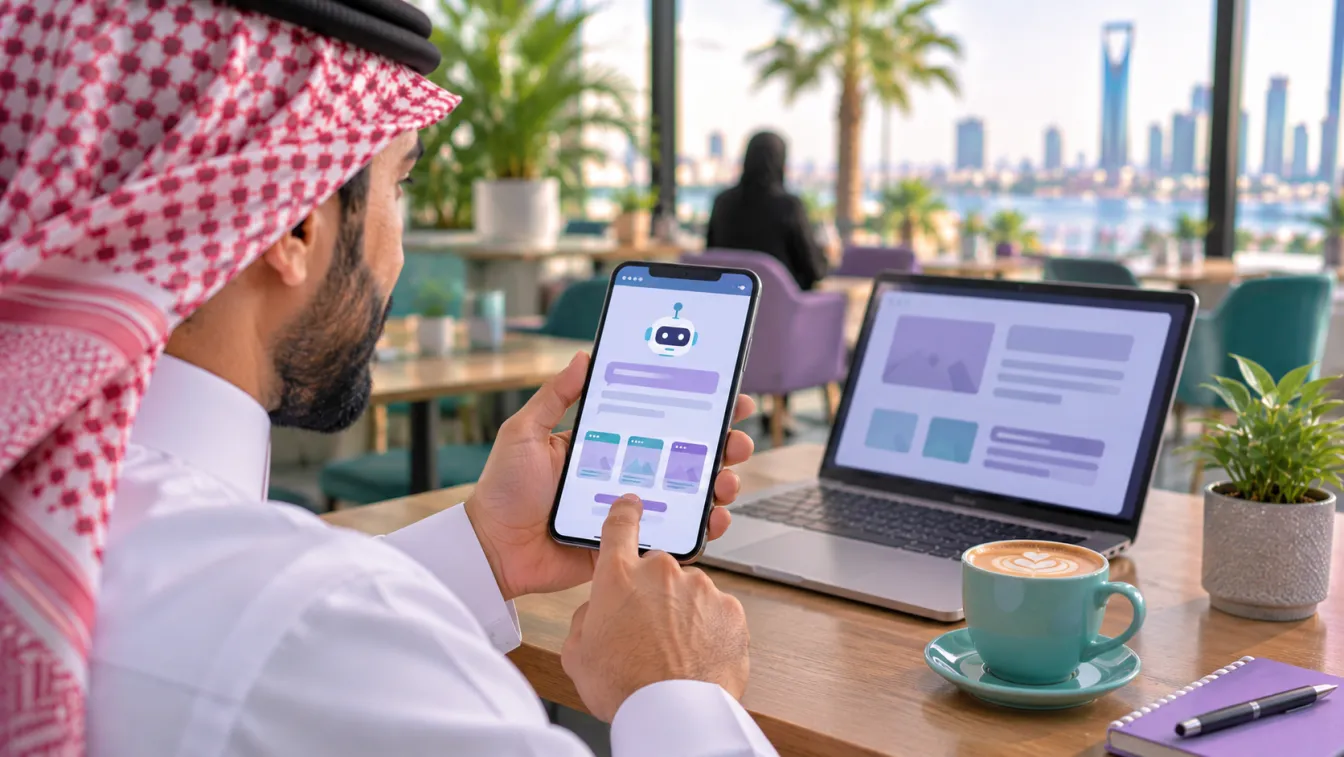
AI business recommendations often begin with a customer's practical question: which company should I choose for this service, in this city, with these requirements? Businesses cannot control whether an AI assistant recommends them, but they can make their information easier for customers to understand, compare and verify. That means explaining what the company does, whom it serves, where it operates and what evidence supports its claims.
For Saudi businesses, this work includes clear Arabic and English service pages, accurate location details, transparent processes, useful customer information and genuine external references. No website change guarantees a recommendation from ChatGPT, Gemini, Copilot, Perplexity or Google's AI answers. The objective is to make the company easier to evaluate while strengthening its overall AI search optimization strategy.
What Are AI Business Recommendations?
AI business recommendations are suggestions or comparisons presented in response to questions about choosing a company, supplier or service provider. A customer might ask for a contractor in Riyadh, an ERP implementation company in Jeddah or a property developer with projects in a particular area.
These questions are different from simple searches for a company name. The customer is asking for help evaluating options against specific needs.
For example, a hypothetical business owner might ask:
- Which ERP provider understands contracting workflows?
- Which digital agency offers both Arabic and English services?
- Which property developer has residential projects in a particular location?
- Which maintenance company serves our branch locations?
- What should I compare before choosing a supplier?
The usefulness of an answer depends on the information available and the context of the question. Businesses should not assume that one description, review or directory listing determines how an AI platform responds.
The practical opportunity is to make your company easier to assess. Clear information helps human customers too, whether they discover you through a search engine, a referral, a directory or an AI-powered experience.
Start With the Customer's Evaluation Criteria
Before changing your website, identify what customers need to know before they choose a provider. Different industries have different decision criteria.
A contracting client may care about project experience, procurement processes, resource coordination and reporting. A company buying software may need to understand implementation scope, integrations, training and support. A property buyer may want accurate project locations, unit details, availability and enquiry procedures.
Collect evaluation questions from:
- Sales conversations and proposal discussions.
- Customer enquiries and support requests.
- Questions raised during demonstrations.
- Procurement and supplier evaluation documents.
- Feedback from customers who chose another provider.
- Conversations with operations and account management teams.
Organise the questions into themes. Common themes include service fit, location, experience, process, requirements, support, evidence and contact options.
For businesses exploring AI search optimization in Riyadh, include questions in the language customers actually use. Some customers may ask in Arabic, others in English, and some may combine local expressions with technical terms. Your website should explain the same underlying services clearly across both languages.
1. Explain Exactly What Your Company Does
A company description should make its actual business activity clear. Generic claims such as "leading solutions provider" or "complete services for every sector" do not help a customer understand whether the company is suitable.
A useful company description should explain:
- The main products or services offered.
- The industries or customer types served.
- The problems the company helps address.
- The geographical areas genuinely covered.
- The main way customers can engage with the business.
For example, a hypothetical Saudi software company might describe itself as providing ERP implementation and custom business applications for contracting and distribution companies. It could then explain the relevant workflows and the type of support available.
This is more informative than describing the business simply as a technology company. It gives customers a clearer starting point for deciding whether to investigate further.
Keep the description consistent across the website, company profiles and relevant directories. If the company has several distinct brands or business units, explain the relationship rather than combining unrelated services into one vague statement.
2. Create Specific Pages for Important Services
Customers evaluating providers need more than a list of service names. They need to understand what each service includes and whether it matches their requirements.
A dedicated service page should answer:
- What exactly is offered?
- Which customer needs does it address?
- What activities or deliverables are included?
- What is outside the normal scope?
- What information is needed to assess a project?
- Which locations can the company serve?
- What is the next step for an interested customer?
For a hypothetical ERP implementation provider, separate pages might explain finance, procurement, inventory, project management and HR workflows. The company should describe the actual services it delivers rather than imply that every module or integration is included in every engagement.
Use clear examples to explain complex services. Identify hypothetical scenarios as examples and do not present them as completed client projects.
A customer should be able to understand the service without having to interpret broad marketing claims. This clarity is especially important when comparing providers with different offerings.
3. Make Location and Service Coverage Unambiguous
Location is often a key part of a customer's decision. A company that operates an office in Riyadh but serves customers across several cities should explain that distinction accurately.
Separate these details:
- Registered or official business address.
- Physical offices and staffed branches.
- Cities where services are genuinely delivered.
- Areas covered remotely or through partners.
- Locations where a particular service is available.
Do not claim to have an office in a city simply because the company accepts enquiries from that location. Similarly, do not imply that every service is available in every branch if the actual offering differs.
Create useful location pages when there is genuine local information to provide. A page for Jeddah should explain the relevant services, coverage and contact arrangements rather than repeat a city name throughout generic copy.
Keep the website aligned with Google Business Profile and relevant business directories. Review addresses, telephone numbers, opening hours and branch details whenever the business changes them.
For companies that need to improve local discovery as well as AI visibility, our local SEO service covers the local search side of this work.
4. Show How Your Service Works
Customers often compare providers by looking at the process, not just the final service description. Explain what happens from the first enquiry to delivery and ongoing support.
A service process might include:
- Initial discussion: Understand the customer's objectives and current situation.
- Requirements review: Identify relevant systems, resources, locations and constraints.
- Scope definition: Clarify the proposed work, responsibilities and deliverables.
- Implementation or delivery: Explain the main stages of the work.
- Handover: Describe documentation, training or operational transition where applicable.
- Ongoing support: Explain what support is available and how customers request it.
The actual process will differ by service. Avoid presenting a generic workflow as a fixed promise when the scope depends on the customer's requirements.
Explain what the customer needs to provide and which decisions may affect the project. This makes the service easier to evaluate and helps avoid misunderstandings during the sales process.
5. Provide Evidence That Supports Your Claims
Customers need a reason to trust the information on a company website. Evidence should support the claims being made and be relevant to the service under consideration.
Depending on the business, useful evidence may include:
- Clear descriptions of the team's relevant professional experience.
- Genuine licences or certifications, where held and applicable.
- Published technical documentation or service specifications.
- Real project examples approved for publication.
- Genuine testimonials with appropriate permission.
- Relevant memberships or partnerships that can be verified.
- Original explanations and educational material demonstrating subject knowledge.
Do not invent client names, project results, qualifications, reviews or partnerships. If you cannot publish a client case study, use a clearly labelled hypothetical example to explain your process instead.
Be precise about what evidence proves. A professional membership does not automatically certify every service, and a supplier relationship does not necessarily mean an official endorsement.
A transparent page can also explain limitations. If a service depends on a site inspection, technical assessment or customer-specific requirements, say so. Honest qualifications help customers compare providers on a realistic basis.
6. Make Comparisons Useful and Fair
Many customer questions involve comparing options. Your website can help by explaining meaningful differences without making unsupported claims about competitors.
For example, an ERP provider could explain the difference between:
- Standard configuration and custom development.
- Cloud-hosted and locally managed deployment options.
- A phased implementation and a broader rollout.
- Core software functionality and additional integrations.
- Included support and separately scoped services.
A useful comparison explains when each option may be appropriate and which questions the customer should ask. It should not claim that one approach is always best.
If your company publishes a comparison between service models or product categories, make the criteria explicit. Explain what is being compared, which conditions may change the decision and where the customer can find more detail.
Avoid unsupported claims that your company is the best, cheapest or most advanced provider in a city. Replace broad superiority statements with specific, verifiable explanations of your actual offering.
7. Keep Your Business Identity Consistent Across the Web
A company may appear on its website, professional profiles, business directories, association pages, event listings and partner websites. These sources should describe the same organisation accurately.
Review:
- Official Arabic and English business names.
- Company descriptions and service categories.
- Website and contact details.
- Office and branch information.
- Genuine relationships with parent companies or brands.
- Links to official social and professional profiles.
For a bilingual Saudi business, make sure the Arabic and English pages describe the same underlying services and business facts. The wording can differ naturally between languages, but the company identity should remain clear.
Correct outdated information on profiles that matter to customers. Do not create duplicate listings or artificial mentions to make the company appear more established.
Our guide to brand entity consistency explains how to align business information across your website and relevant external sources.
8. Build Useful Third-Party References
Your own website is where you control the official description of your business. Relevant external sources can provide additional context, provided they are genuine and accurate.
Depending on your industry, useful sources may include:
- Relevant Saudi business directories.
- Professional and industry associations.
- Trade publications and credible media.
- Genuine supplier and partner profiles.
- Event pages that accurately list participation.
- Professional profiles managed by the company.
Prioritise relevance and accuracy over the number of mentions. A genuine industry reference is more useful to a customer than a collection of unrelated listings or paid placements that disguise their promotional nature.
Review external descriptions for outdated services, incorrect locations and confusing brand names. Request corrections through the appropriate publisher or profile owner when needed.
Third-party references may provide useful context, but they do not guarantee AI business recommendations or prove that a company is suitable for every customer.
9. Review How Your Company Appears in Real Customer Questions
A practical visibility review should reflect the questions customers ask when choosing a provider, not just searches for your company name.
Create a fixed set of questions in Arabic and English. Include different evaluation needs, such as:
- Finding a provider for a specific service in a city.
- Comparing companies with a particular industry focus.
- Understanding which services a business offers.
- Checking whether a provider serves a particular location.
- Identifying what to consider before choosing a supplier.
Run the same questions across relevant AI search experiences and document what is visible. Record whether your company is mentioned, how it is described, which sources are cited and whether the answer contains inaccurate details.
Do not treat a single response as a definitive ranking or assume that results will be identical for every user. Different questions and platforms may produce different answers.
Use the findings to identify information gaps. If the company is described incorrectly, review its official business information. If the service scope is unclear, improve the relevant page. If an external source is outdated, request a correction where appropriate.
How LtsThink Helps Make Your Business Easier to Evaluate
LtsThink approaches AI business recommendations as a business information and visibility challenge, not a promise to secure a place in an AI-generated shortlist.
Our AI search optimization work reviews how your company explains its identity, services, locations and expertise. We examine the questions real customers ask, then assess whether the website and relevant external sources provide clear, consistent information to help people evaluate the business.
The work may include:
- Reviewing Arabic and English buyer questions.
- Clarifying company and service descriptions.
- Improving service and location pages.
- Reviewing evidence, FAQs and customer-facing information.
- Checking business identity across relevant profiles.
- Identifying useful third-party references and outdated information.
- Reviewing visible AI answers and citations using a consistent question set.
- Documenting corrections and content improvements in a recurring report.
We do not guarantee that ChatGPT, Gemini, Copilot, Perplexity or Google's AI answers will recommend or cite your company. We focus on improving the accuracy, clarity and accessibility of the information customers can use to assess your business.
Explore our AI search optimization service to understand how this work fits into a wider programme covering technical access, citable content, entity consistency and external presence.
Work with us: Want to make your company easier for customers to understand and evaluate? Explore our AI search optimization service or read our guide to AI search citations.
FAQ
Can I guarantee that AI tools will recommend my company?
No. Businesses can improve the accuracy and clarity of their public information, but they cannot guarantee that ChatGPT or another AI platform will recommend, mention or cite them.
What information helps customers evaluate a Saudi business?
Useful information includes the company's actual services, industries served, locations, process, requirements, contact details and evidence supporting relevant claims. The exact information depends on the customer's decision and the type of business.
Should I create a separate page for every city I serve?
Only when there is genuine local information to provide. A useful location page should explain actual service coverage, relevant offerings and contact arrangements. Avoid creating near-identical pages that only change the city name.
Do online reviews determine AI business recommendations?
Reviews may be one part of a customer's wider research, but they should not be treated as the sole basis for a recommendation. Focus on genuine customer feedback, accurate business information and evidence that helps people assess whether the service is suitable.


